This guide brings all our winter activities for preschoolers into one place: letters, math, fine motor, weather, science, sensory bins, snowflakes, playdough mats, hibernation, arctic animals and indoor ideas for freezing days.
Each activity takes 10 to 20 minutes, uses simple supplies and is made for 3 to 5 year olds. Use it as a winter learning plan: pick one theme a week and do two activities from it.
Winter Letters
Snowy letter hunts and mitten ABCs.
1. Snowball Letter Toss
Throw a snowball and say the letter it lands on.
Snowball letter toss combines throwing with letters. Spread letter cards on the floor, scrunch paper into snowballs, call a letter and toss a snowball onto it. Multi-sensory letter games, where children see, say, touch and move, help letters stick in memory much better than flashcards alone.
What your child learns: Aiming builds coordination, and finding the right letter builds recognition.
Make it easier or harder: Use 4 or 5 letters at first. Older kids can toss at the letter that starts a word.
How to play Snowball Letter Toss
- Spread letter cards on the floor.
- Scrunch paper into snowballs.
- Your child throws a snowball and names the letter it lands on.
- Say a word that starts with it.
2. Mitten Letter Match
Match uppercase and lowercase letters on mitten pairs.
Mitten letter match pairs uppercase and lowercase letters. Write an uppercase letter on one mitten and its lowercase on the other, then mix and find the pairs.
What your child learns: Connecting big and small letters is an important pre-reading skill.
Make it easier or harder: Start with letters that look alike, like O and o. Add harder ones later.
How to play Mitten Letter Match
- Write an uppercase letter on one mitten and the lowercase on its pair.
- Mix them up.
- Your child finds each matching pair.
- Peg them on a string like a washing line.
Winter Math
Count snowballs, measure icicles and sort mittens.
3. Snowball Counting Cups
Put the right number of snowballs in each cup.
Snowball counting cups is a winter number game. Write numbers 1 to 10 on paper cups and have your child fill each cup with that many white pom pom snowballs. Short, hands-on math games build number sense better than worksheets at this age, because children can see and touch each quantity.
What your child learns: Matching numbers to amounts builds one-to-one counting and number recognition.
Make it easier or harder: Use 1 to 5 for younger kids. Older ones can line the cups up in order.
How to play Snowball Counting Cups
- Write numbers 1 to 10 on paper cups.
- Give your child white pom poms and tongs.
- Fill each cup with the matching number.
- Count to check.
4. Mitten Number Match
Match a mitten with a number to a mitten with dots.
Mitten number match pairs numbers with dots. Cut out mitten pairs, write a number on one and draw that many dots on the other, then mix and match.
What your child learns: Matching a numeral to a dot set connects symbols with quantity.
Make it easier or harder: Start with 1 to 5. Older kids can match up to 10.
How to play Mitten Number Match
- Cut out mitten pairs.
- Write a number on one and draw that many dots on the other.
- Mix them up.
- Your child finds each matching pair.
Fine Motor
Pinch, thread and cut with a cold-weather theme.
5. Snowball Tweezer Transfer
Move pom pom snowballs into an ice tray with tweezers.
Snowball tweezer transfer is a quiet winter tray activity. Put white pom poms in a bowl and give your child kid-sized tweezers to move each snowball into an ice cube tray. Strong, coordinated fingers make holding a pencil, cutting with scissors and doing up buttons much easier when children start school.
What your child learns: Squeezing tweezers builds the same muscles used to hold a pencil.
Make it easier or harder: Start with tongs, then move to tweezers. Count the snowballs as they go.
How to do Snowball Tweezer Transfer
- Put white pom poms in a bowl.
- Give your child kid-sized tweezers or tongs.
- Move one snowball into each ice cube space.
- Count them when the tray is full.
6. Snowflake Lacing
Lace yarn through a card snowflake.
Snowflake lacing is a calm fine motor craft. Cut a snowflake shape from card, punch holes around it, tape the end of some yarn and lace in and out.
What your child learns: Lacing builds hand eye coordination and two-handed skills.
Make it easier or harder: Use fewer holes for beginners. Hang finished snowflakes in a window.
How to do Snowflake Lacing
- Cut a snowflake shape from card.
- Punch holes around it.
- Tape the end of white yarn.
- Lace in and out around the snowflake.
Weather Watch
Talk about snow, wind and cold with simple charts.
7. Daily Weather Chart
Record the weather each day with a picture.
A daily weather chart makes weather part of the morning routine. Make a chart with the days of the week, draw or cut out weather pictures and add one each day after looking outside. Talking about the weather every day is a simple science routine that builds vocabulary like cloudy, windy and freezing, and helps children notice patterns over time.
What your child learns: Recording the weather builds observation and introduces simple data.
Make it easier or harder: Count sunny and snowy days at the end of the week. Older kids can graph the results.
How to try Daily Weather Chart
- Make a chart with days of the week.
- Draw or cut out weather pictures: sun, cloud, rain, snow, wind.
- Each morning, look outside and stick the matching picture.
- At the end of the week, count each type.
8. Rain Cloud in a Jar
Shaving foam clouds rain colored drops.
A rain cloud in a jar shows how rain falls. Fill a jar with water, add a layer of shaving foam on top as a cloud and drip blue food coloring onto it until it “rains”.
What your child learns: Kids see that clouds hold water until they get too full, a simple weather lesson.
Make it easier or harder: Use droppers for control. Talk about what happens when real clouds get heavy.
How to try Rain Cloud in a Jar
- Fill a jar with water.
- Add a layer of shaving foam on top as a cloud.
- Drip blue food coloring onto the foam.
- Watch it rain through the cloud.
🎉 Fun break! Time for a silly little game
Three activities down already. Your brain deserves a tiny party! Grab your little one, play this one minute game together, then scroll on for more ideas.
Winter Science
Melting, freezing and frost experiments.
9. Ice Melting Race
Which melts ice fastest: salt, sugar or nothing?
An ice melting race compares what melts ice fastest. Put three ice cubes on three plates, sprinkle salt on one, sugar on another and leave the third plain, then watch. Ask your child to predict what will happen before each test. Guessing, testing and talking about results is how preschoolers start thinking like scientists.
What your child learns: Kids learn that salt lowers the melting point of ice, which is why roads are salted in winter.
Make it easier or harder: Check every five minutes. Older kids can draw what each cube looks like.
How to try Ice Melting Race
- Put three ice cubes on three plates.
- Sprinkle salt on one, sugar on another and leave one plain.
- Ask your child to guess which will melt first.
- Check every 5 minutes and talk about it.
10. Snowstorm in a Jar
A fizzy tablet makes white bubbles swirl like a blizzard.
A snowstorm in a jar is a fizzy winter experiment. Fill a jar three quarters with baby oil, mix water with white paint, pour it in and drop in a piece of fizzing tablet.
What your child learns: Bubbles carry the white water up through the oil, showing that oil and water do not mix.
Make it easier or harder: An adult should handle the tablet. Use a plastic jar.
How to try Snowstorm in a Jar
- Fill a jar three quarters with baby oil.
- Mix water with white paint and pour it in.
- Drop in a piece of a fizzy antacid tablet.
- Watch the snowstorm swirl.
Winter Sensory Bins
Snowy fillers to scoop, pour and explore.
11. Fake Snow Bin
Baking soda and conditioner make cool, moldable fake snow.
A fake snow bin brings winter indoors. Pour 3 cups of baking soda into a bin, add about half a cup of white hair conditioner and mix until it feels cold and moldable like snow. Sensory bins let preschoolers explore with their hands while building vocabulary, fine motor skills and pretend play. Put a towel or tray underneath for easy clean up.
What your child learns: Squeezing and molding snow builds hand strength and invites creative play.
Make it easier or harder: Add small toys and scoops. Older kids can build tiny snowmen.
How to make Fake Snow Bin
- Pour 3 cups of baking soda into a bin.
- Add half a cup of white hair conditioner.
- Mix with hands until it feels like snow.
- Add scoops, cups and little toys.
12. Arctic Animal Bin
Polar bears, penguins and seals in a snowy world.
An arctic animal bin is a small world of snow and ice. Fill a bin with cotton balls or fake snow, add blue paper “water” and toy polar animals.
What your child learns: Playing with arctic animals builds science vocabulary about cold habitats.
Make it easier or harder: Talk about how animals stay warm. Older kids can sort animals by land and sea.
How to make Arctic Animal Bin
- Fill a bin with cotton balls or fake snow.
- Add a few blue paper pieces as icy water.
- Add toy polar animals.
- Talk about where each animal lives.
Snowflakes
Count, match and build six-sided snowflakes.
13. Snowflake Counting
Count paper snowflakes onto number cards.
Snowflake counting is a gentle winter math game. Cut out lots of small paper snowflakes, lay number cards from 1 to 10 and place that many snowflakes on each card. Every snowflake has six sides or arms because of the way water molecules freeze together, a fun fact that turns snowflake play into science.
What your child learns: Matching numbers to quantities builds one-to-one counting.
Make it easier or harder: Use 1 to 5 for younger kids. Older ones can count by twos.
How to try Snowflake Counting
- Cut out lots of small paper snowflakes.
- Lay number cards from 1 to 10.
- Put the right number of snowflakes on each card.
- Count together.
14. Salt Painting Snowflakes
Glue and salt snowflakes that soak up watercolor.
Salt painting snowflakes sparkle like real ice. Draw a snowflake with white glue on dark card, pour salt over it, shake off the extra and dab watercolor on the salt.
What your child learns: Kids watch color spread through the salt, a fun science and art moment.
Make it easier or harder: Use droppers for the paint. Let it dry flat overnight.
How to try Salt Painting Snowflakes
- Draw a snowflake with white glue on dark card.
- Pour salt over the glue and shake off the extra.
- Dab watercolor onto the salt with a brush.
- Watch the color spread.
Playdough Mats
Snowmen and mittens to build with dough.
15. Build a Snowman
Roll three balls to finish the snowman.
Build a snowman is the easiest winter playdough mat. Draw a snowman outline, roll three white dough balls in different sizes, then add a hat, arms and a face.
What your child learns: Rolling, pinching and pressing playdough strengthens the small hand muscles preschoolers need for holding a pencil and using scissors. Making small, medium and large balls adds size comparison.
Make it easier or harder: Slip the mat into a page protector so it can be reused. Older kids can add buttons and a scarf.
How to use Build a Snowman
- Draw a snowman outline.
- Roll three white dough balls.
- Add a hat, buttons and a carrot nose.
16. Count the Snowballs
Counting and rolling together.
Count the snowballs turns playdough into math. Write a number on each snowman and roll that many tiny snowballs to place next to it.
What your child learns: Matching a number to a set of objects builds one-to-one counting and number sense.
Make it easier or harder: Use numbers 1 to 5 for younger kids. Older preschoolers can try up to 10.
How to use Count the Snowballs
- Write a number on each snowman.
- Roll that many tiny snowballs.
- Place them on the mat.
Hibernation
Learn how bears and other animals sleep through winter.
17. Build a Bear Cave
Turn a table into a cave where teddy can hibernate.
Building a bear cave is the perfect start to a hibernation theme. Drape blankets over a table to make a dark cave, add pillows and a teddy bear, and talk about how bears sleep through winter.
What your child learns: Pretend play helps preschoolers understand a new science idea: some animals slow down and rest when food is hard to find in winter.
Make it easier or harder: Keep a flashlight inside for kids who dislike the dark. Older kids can design the cave themselves.
How to try Build a Bear Cave
- Drape blankets over a table to make a dark cave.
- Add pillows and a flashlight.
- Tuck teddy bears inside to sleep.
- Tiptoe and whisper near the cave.
18. Who Hibernates Sort
Sort animals that hibernate and animals that stay awake.
Who hibernates sort is a simple science sorting game. Gather pictures of bears, hedgehogs, deer, birds and foxes, and sort them into “hibernates”, “migrates” and “stays active”.
What your child learns: Sorting animals by behavior builds classification skills and science vocabulary.
Make it easier or harder: Use two groups for younger kids. Older ones can find more animals in books.
How to try Who Hibernates Sort
- Gather pictures of bears, hedgehogs, deer, birds and foxes.
- Make two mats: sleeps all winter and stays awake.
- Sort each animal.
- Talk about how the awake animals find food.
Arctic Animals
Penguins, polar bears and seals up close.
19. Blubber Glove Experiment
Feel how blubber keeps arctic animals warm.
The blubber glove experiment shows how arctic animals stay warm. Fill a zip bag with vegetable shortening, put a second bag inside it to make a glove, and dip both hands in icy water to compare. The Arctic is the icy area around the North Pole, home to polar bears, seals, walruses and arctic foxes. Learning about animal homes is an early science topic called habitats.
What your child learns: Children feel how a fat layer insulates, just like a seal or polar bear’s blubber.
Make it easier or harder: Tape the bags together so shortening stays inside. Time how long each hand stays comfortable.
How to try Blubber Glove Experiment
- Fill a zip bag with vegetable shortening and put a second bag inside it to make a glove.
- Fill a bowl with ice water.
- Put one bare hand and one blubber glove hand in the water.
- Talk about which hand stays warmer.
20. Polar Animal Sort
Sort animals into cold places and hot places.
A polar animal sort teaches habitats. Gather pictures or toys of different animals, make two mats for “Arctic” and “not Arctic” and sort them.
What your child learns: Sorting animals by where they live builds classification and science vocabulary.
Make it easier or harder: Use a few clear examples first. Older kids can add a “both poles” group.
How to try Polar Animal Sort
- Gather pictures or toys of different animals.
- Make two mats: one icy blue, one sunny yellow.
- Sort each animal onto the right mat.
- Talk about what helps them live there.
Indoor Days
Big fun for small spaces on freezing days.
21. Ice Painting
Painting with frozen paint feels like magic.
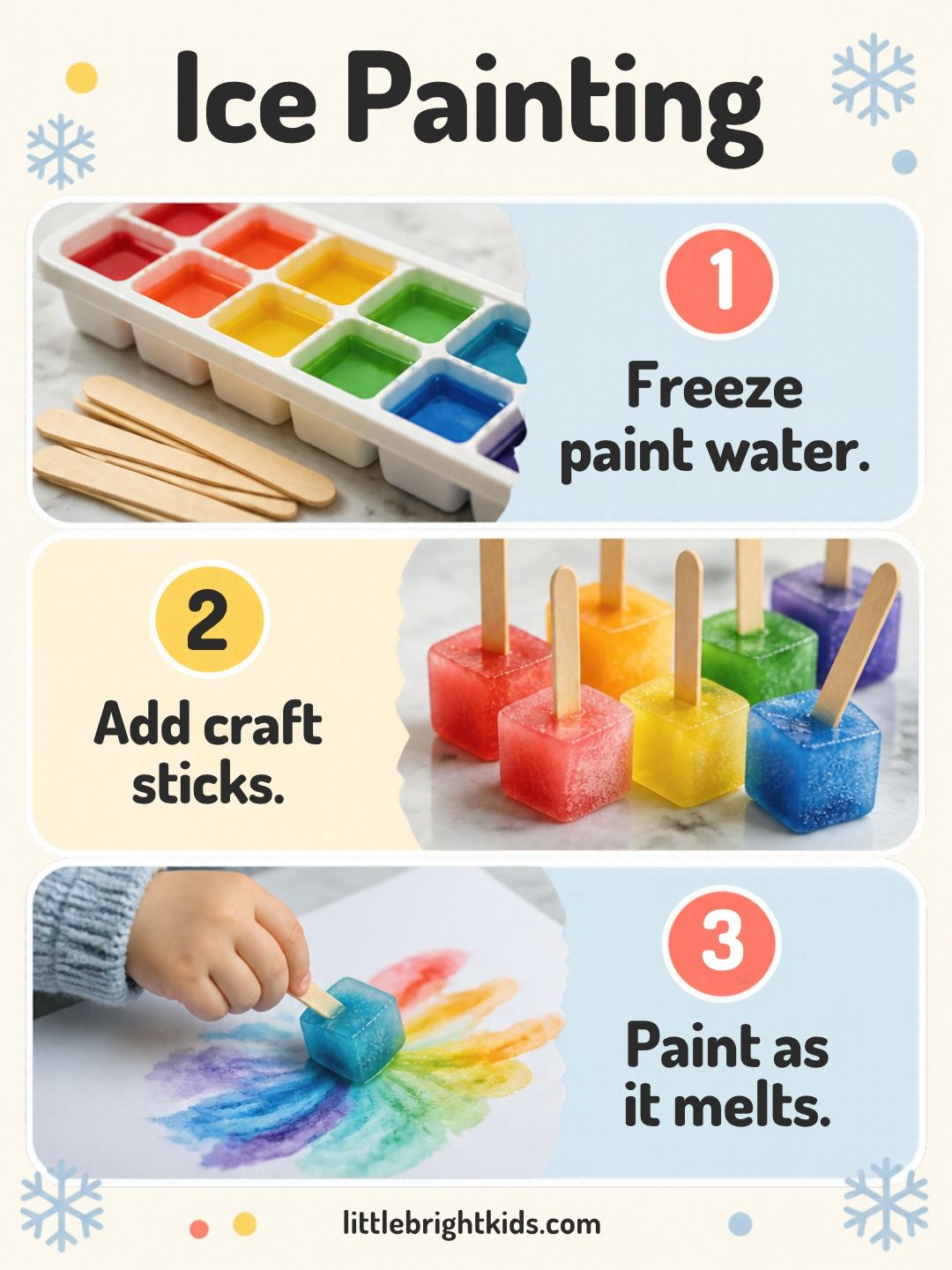
Ice painting is a cool art and science activity for winter days. Freeze water with a drop of washable paint in an ice tray, add craft sticks as handles before freezing, then paint on thick paper as the ice melts.
What your child learns: Children watch ice change from solid to liquid as they paint, a hands-on look at melting. Holding the stick builds grip and control.
Make it easier or harder: Use bigger cubes for small hands. Older preschoolers can mix colors on the paper and predict which cube melts first.
How to do Ice Painting
- Freeze water with a drop of paint in an ice tray.
- Add craft sticks before freezing.
- Paint on thick paper as the ice melts.
22. Paper Snowflakes
Every snowflake is different, just like real ones.
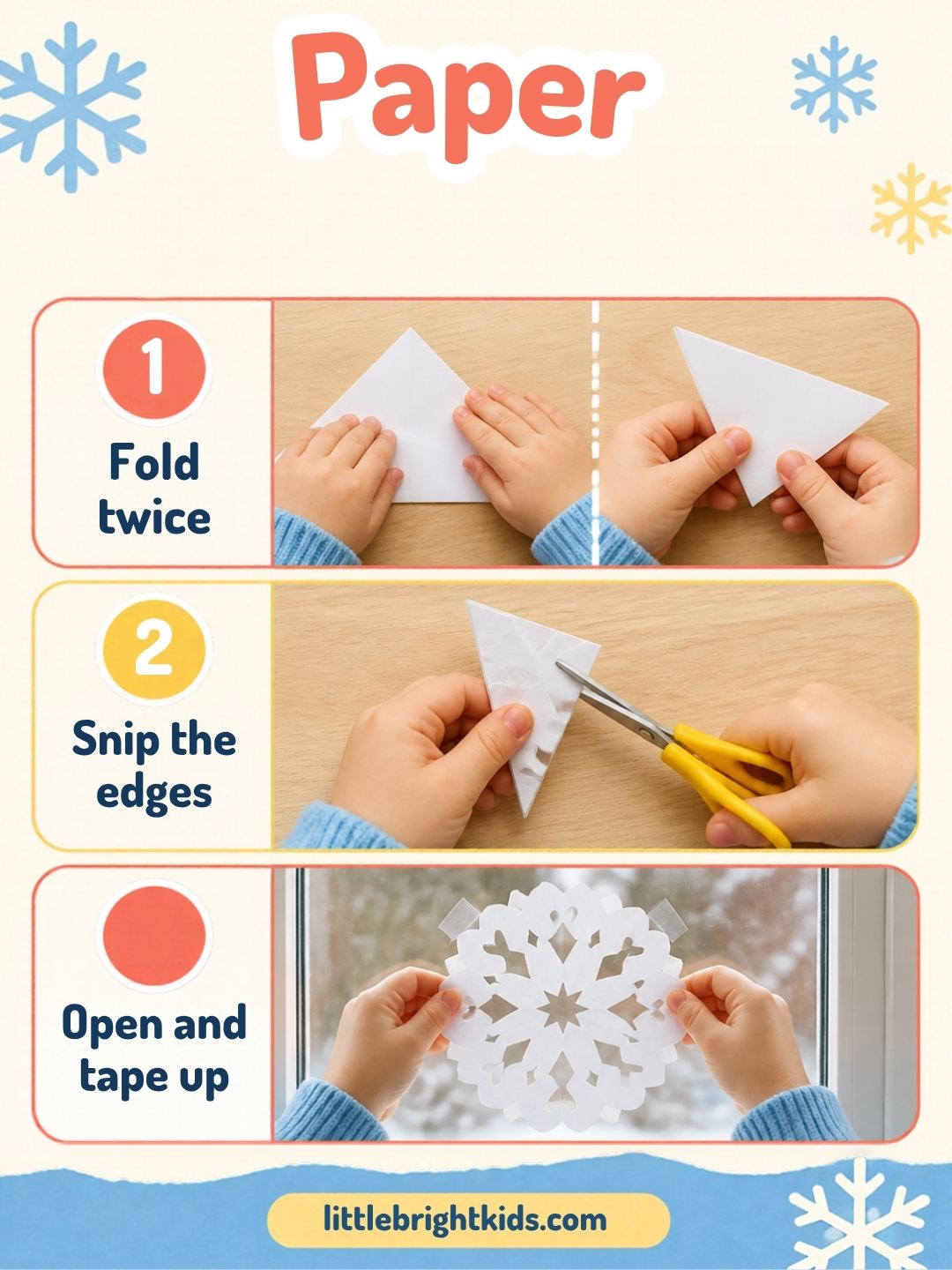
Paper snowflakes are a classic winter craft and a great scissor workout. Fold a square of paper into a triangle twice, snip small shapes along the edges, then open it up and tape it to a window.
What your child learns: Folding and cutting build fine motor skills, and opening the snowflake shows symmetry in a magical way.
Make it easier or harder: Use thin paper for easier cutting. Older children can plan their cuts and compare how every snowflake is different.
How to do Paper Snowflakes
- Fold a square of paper into a triangle twice.
- Snip small shapes along the edges.
- Open it up and tape it to a window.
Questions parents ask
What are good winter activities for preschoolers?
Snowflake counting, ice melting experiments, mitten matching, winter sensory bins and arctic animal sorting are easy, hands-on favourites.
What winter science works for 3 to 5 year olds?
Freeze small toys in ice and let your child melt them with warm water and salt, or watch frost form on a cold can.
How do I teach hibernation to preschoolers?
Build a blanket cave, read a bear story and sort animals into hibernate, migrate and adapt groups.
What can preschoolers do indoors in winter?
Indoor snowball games with paper, obstacle courses, playdough mats and sensory bins keep them busy inside.
How long should winter learning activities last?
About 10 to 20 minutes. Short and playful works best at this age.