
A simple bead abacus might be the best math toy for little kids. Every bead is one number your child can touch, slide and count.
These 5 abacus counting activities start easy and grow with your preschooler, from counting to 10 all the way to skip counting by 2s and 5s.
1. Count 1 to 10 Out Loud
The first and most important game. Sliding one bead for every number builds one to one counting.
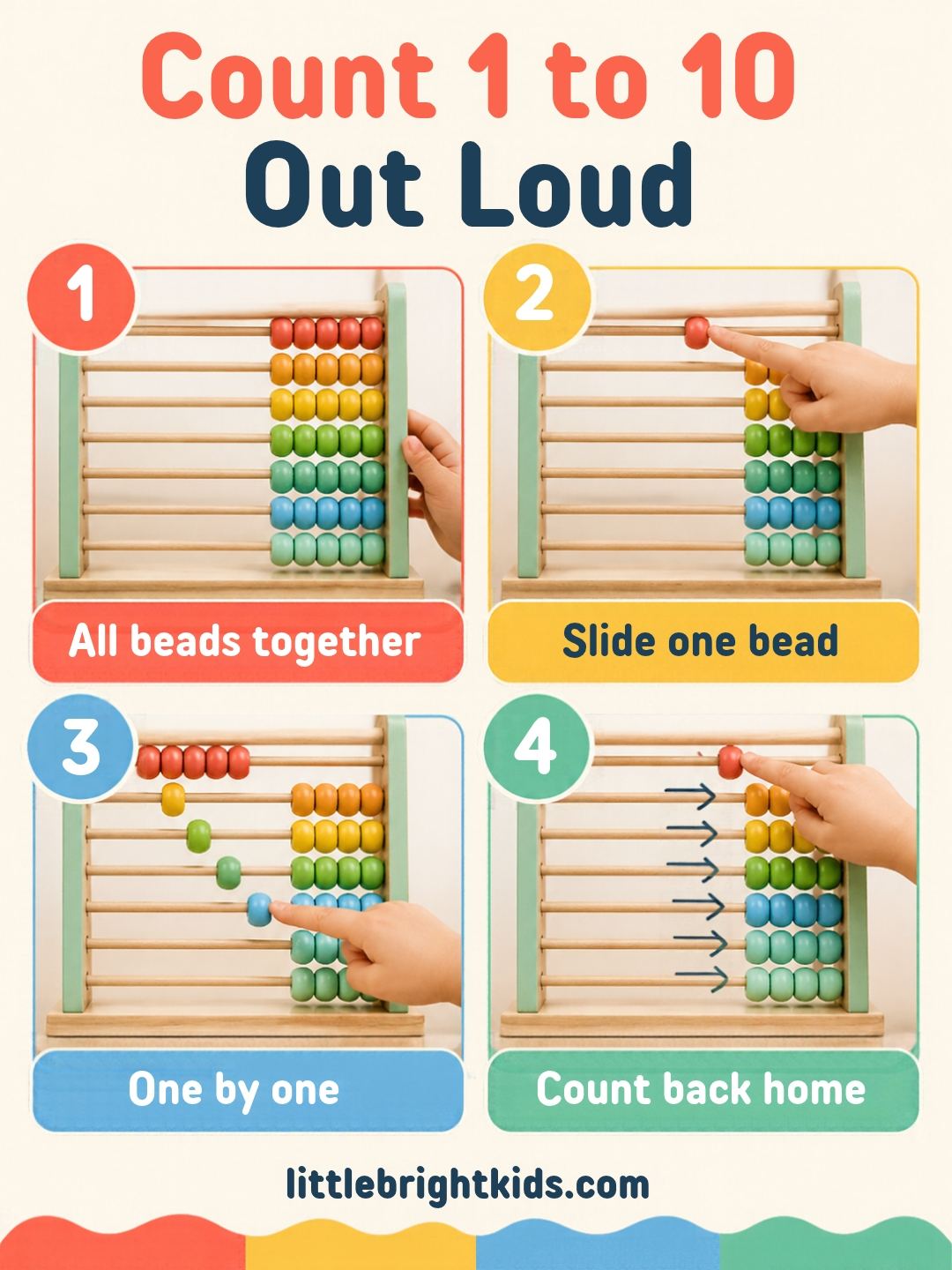
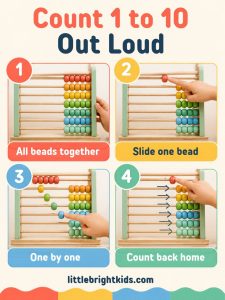
Counting out loud while sliding one bead at a time is the first and most important abacus game. Each bead moves when a number is said, so your preschooler can see and feel exactly what “one”, “two” and “three” mean. Counting back down to zero at the end turns it into a little countdown game kids love.
What your child learns: This builds one to one correspondence, the understanding that each number word matches exactly one object. It is the foundation for all later math, from adding to telling time.
Make it easier or harder: Stop at 5 for younger children and count slowly together. Older preschoolers can start from any number, like 4, and count on to 10 or 20.
How to play Count 1 to 10 Out Loud
- Start with all beads on one side.
- Slide one bead and say one.
- Keep going, one bead and one number at a time, up to 10.
- Count backwards from 10 to slide them home.
💡 If 10 feels like a lot, stop at 5 for the first week.
2. Make Color Patterns
Patterns are early math thinking. Kids learn to spot what comes next.
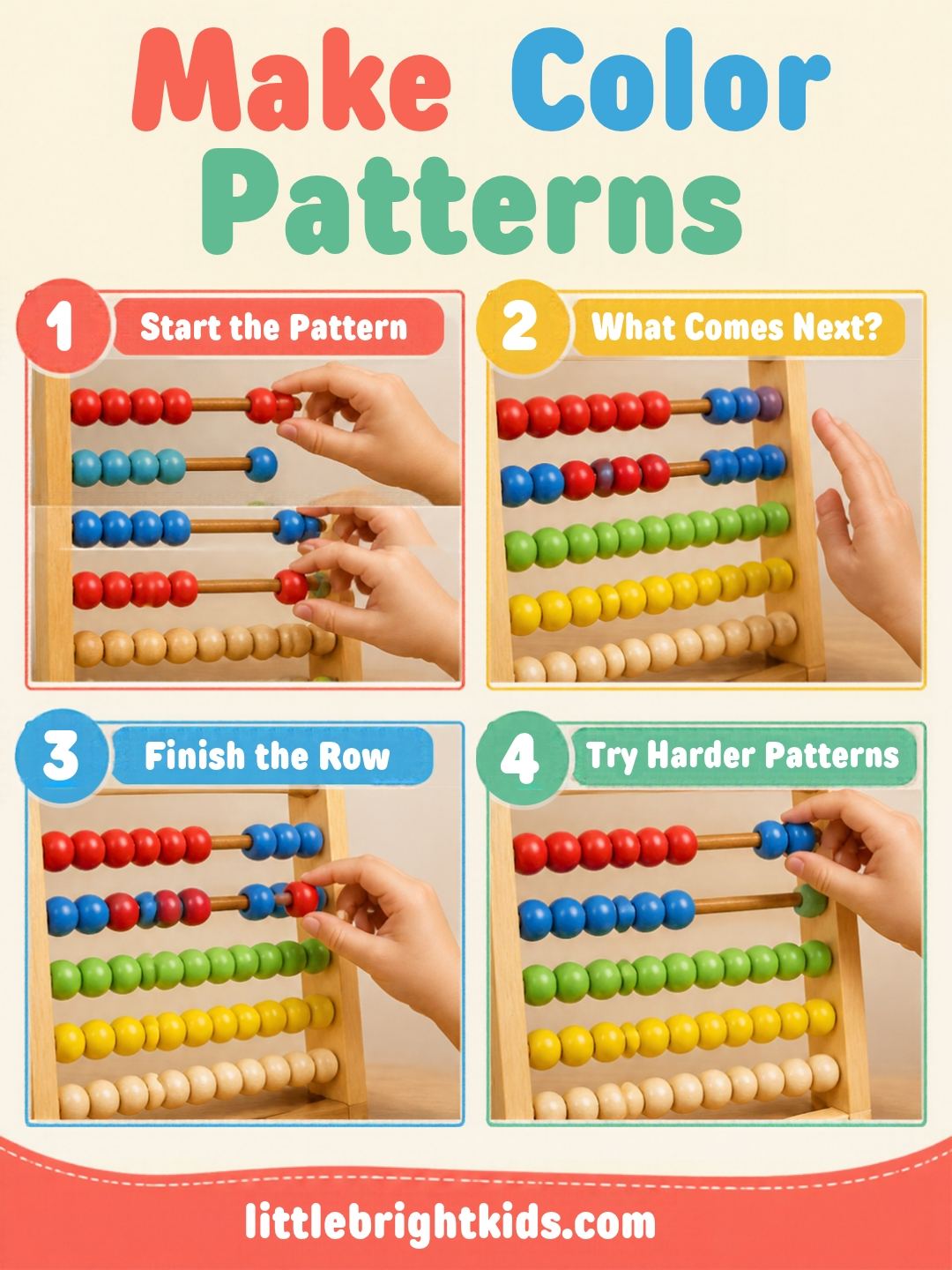
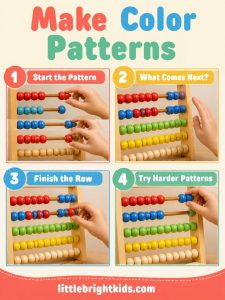
An abacus is perfect for patterns because every row is a neat line of colored beads. You start a simple red, blue, red pattern, then your child decides what comes next and finishes the row. Saying the colors out loud makes the rhythm of the pattern easy to hear.
What your child learns: Spotting and continuing patterns is an early algebra skill. It teaches children to predict, check and fix mistakes, and it strengthens color names and focus.
Make it easier or harder: Begin with two colors that alternate. When that feels easy, try three part patterns such as red, red, blue, or ask your child to invent a pattern for you to finish.
How to play Make Color Patterns
- Slide 1 red bead, 1 blue bead, 1 red bead.
- Ask: what comes next?
- Let your child finish the pattern on the next row.
- Try harder patterns like red, red, blue.
3. Add 2 + 3 With Beads
Kids see that adding just means putting groups together.
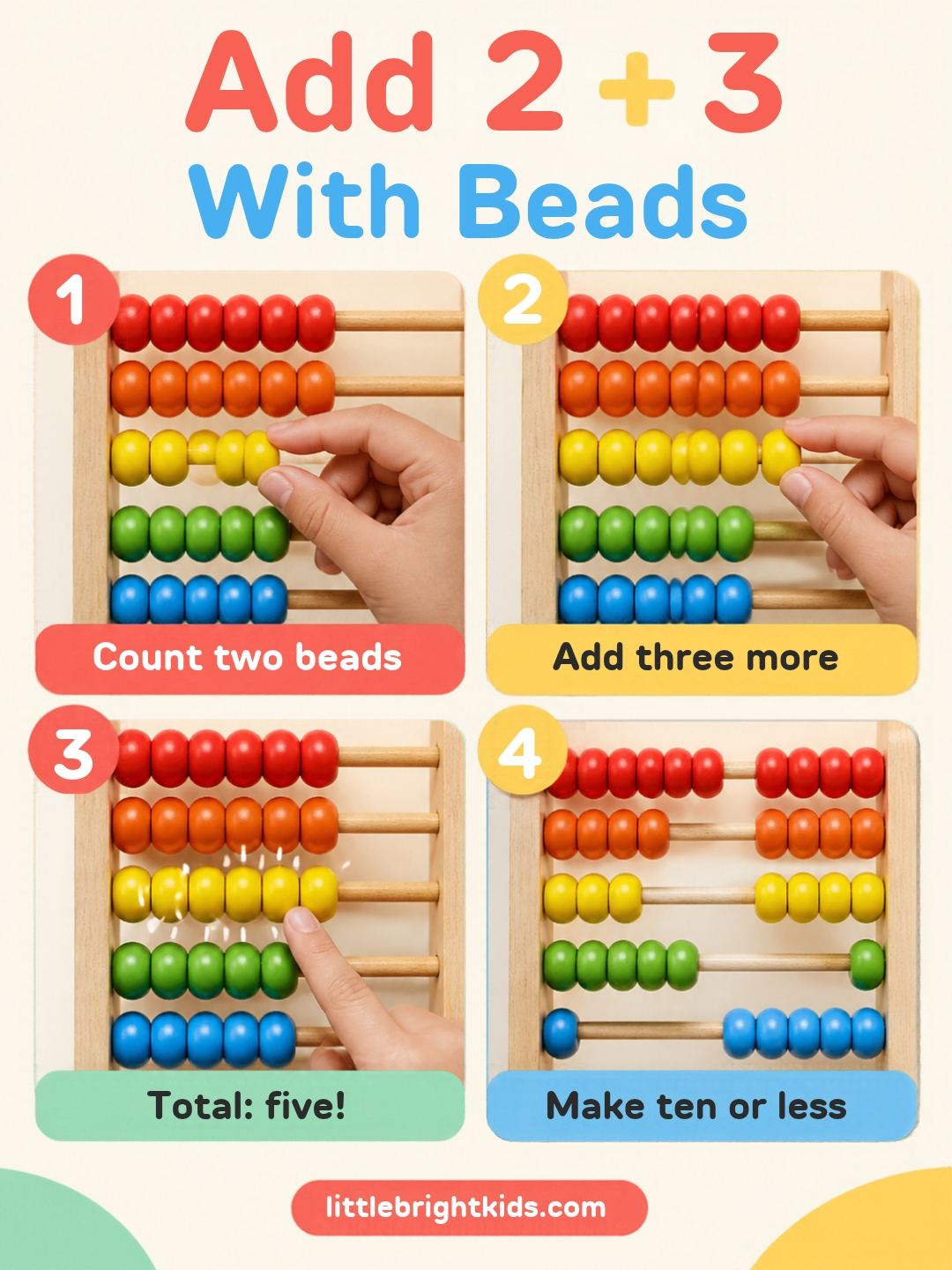
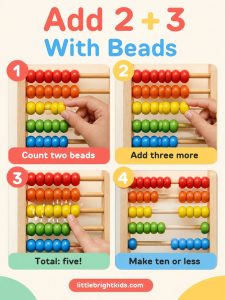
Adding with beads makes math visible. Your child slides two beads, then three more, and counts them all together to find five. Because the beads stay in front of them, they can check the answer as many times as they need without any pressure.
What your child learns: This shows that addition simply means putting groups together. It also builds number sense and early memory of number bonds, like 2 and 3 making 5.
Make it easier or harder: Keep totals under 5 for young learners. For older kids, explore every pair that makes 10, such as 6 and 4 or 7 and 3, and write the sums down together.
How to play Add 2 + 3 With Beads
- Slide 2 beads to the left and count them.
- Slide 3 more beads next to them.
- Count all the beads together: 5!
- Try new pairs that add up to 10 or less.
🤸 Wiggle break! Quick game ahead
Reading is great, but wiggling is better. Tap, giggle and play this little game with your child, then come back for the next activity.
4. Count by 2s and 5s
Skip counting is a big step toward multiplication later on.
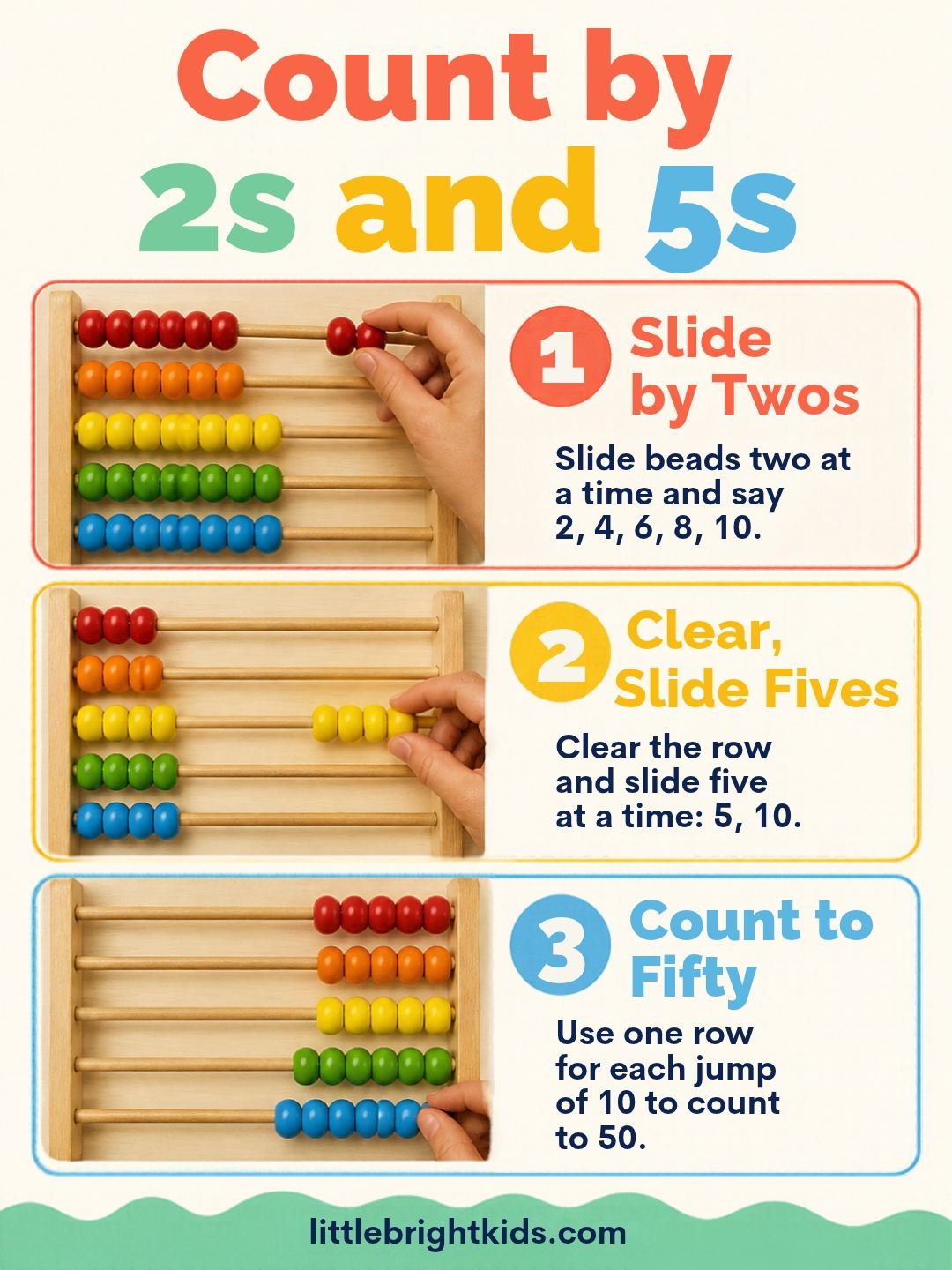
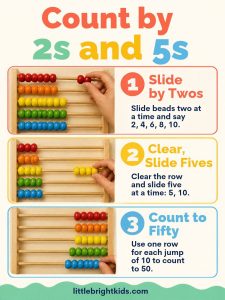
Skip counting on an abacus helps children see that numbers can grow in jumps. Sliding two beads at a time and saying 2, 4, 6, 8, 10 has a fun rhythm, and moving five at a time quickly reaches bigger numbers like 50.
What your child learns: Skip counting prepares kids for multiplication, counting money and telling time in fives. It also strengthens memory and number patterns.
Make it easier or harder: Start with counting by 2s to 10 only. Older preschoolers can try counting by 10s to 100 using one row per ten, which is a big confidence boost.
How to play Count by 2s and 5s
- Slide beads two at a time and say 2, 4, 6, 8, 10.
- Clear the row and slide five at a time: 5, 10.
- Use one row for each jump of 10 to count to 50.
5. Show How Old You Are
A personal number makes counting feel special.
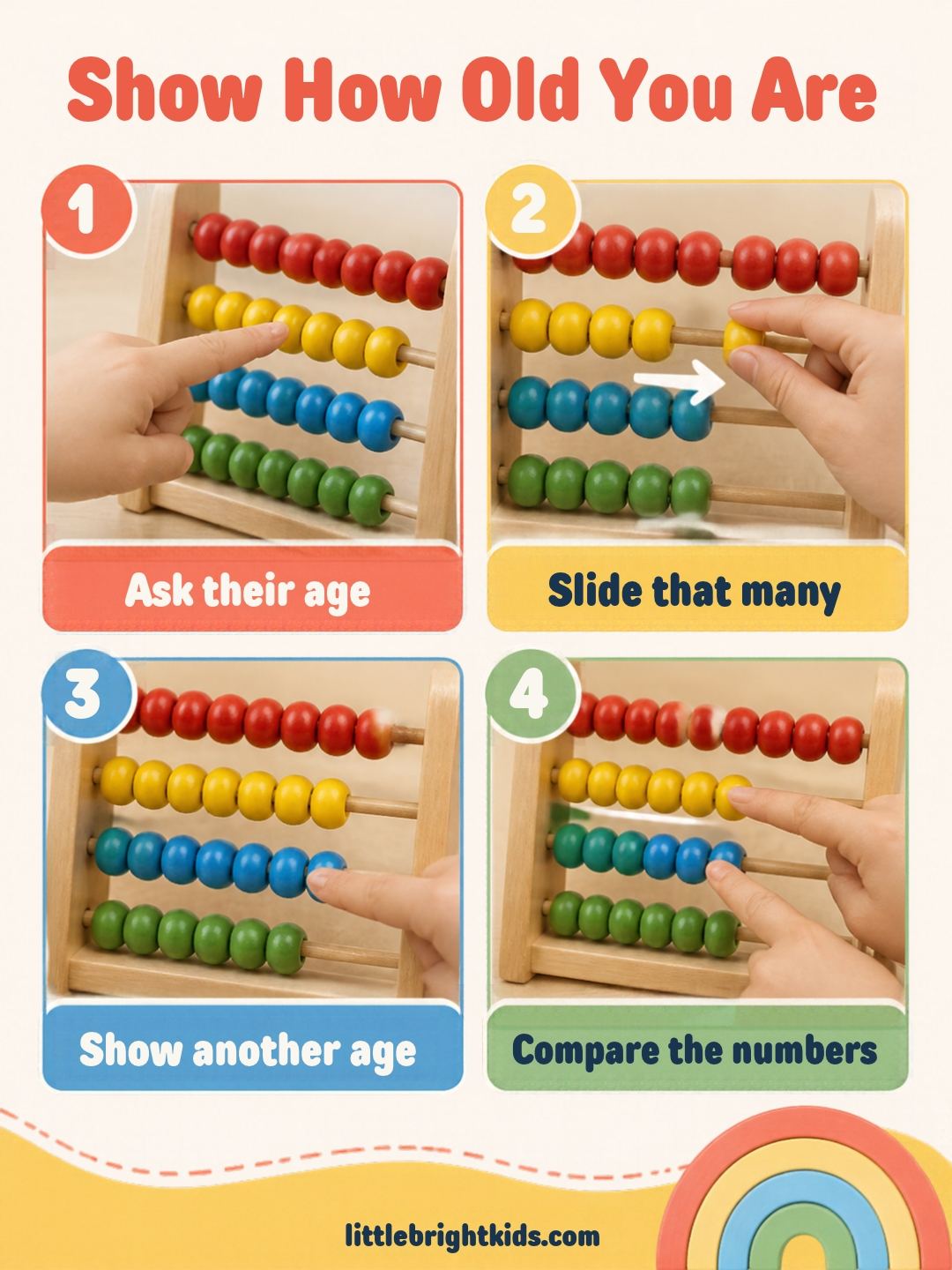
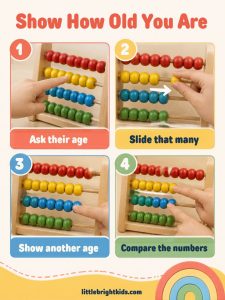
Showing their own age on the abacus makes numbers personal and exciting for kids. They slide beads for their age, then for a sibling, pet or grandparent, and compare who is older. It turns into a fun family conversation about birthdays.
What your child learns: Comparing two rows of beads teaches the ideas of more, less and equal. It also links numbers to real life, which helps children understand why counting matters.
Make it easier or harder: For little ones, compare just two people. Older kids can line up the whole family from youngest to oldest and work out how many years apart they are.
How to play Show How Old You Are
- Ask your child how old they are.
- Let them slide that many beads.
- Now show how old a sibling, a pet or Grandma is.
- Talk about which number is bigger.
5 games at a glance
| Game | Ages | Time | Level |
|---|---|---|---|
| Count 1 to 10 Out Loud | 3 to 5 | 5 min | Easy |
| Make Color Patterns | 3 to 5 | 10 min | Easy |
| Add 2 + 3 With Beads | 4 to 6 | 10 min | Medium |
| Count by 2s and 5s | 5 to 6 | 10 min | Medium |
| Show How Old You Are | 3 to 5 | 5 min | Easy |
The easiest abacus games for preschoolers are counting 1 to 10 out loud, making color patterns, and adding small numbers like 2 + 3 with beads. Each game takes about 5 to 10 minutes and only needs a simple bead abacus.
Free printables to practice at home
Use a counting page after abacus time to practice writing the numbers too.
Tips for abacus time
Keep the abacus somewhere your child can reach it. Kids use it more when it is part of everyday play.
Let them count real things too, like spoons or toy cars, then show the same number on the abacus.
Praise effort and keep it light. Five minutes of happy counting is plenty for a preschooler.
Questions parents ask
Is an abacus good for preschoolers?
Yes. An abacus lets young kids see and touch numbers, which helps with counting, patterns and simple adding.
What age can a child use an abacus?
Most children can start simple counting on an abacus around age 3, with adding and skip counting around ages 5 and 6.
What should my preschooler learn first on an abacus?
Start with counting 1 to 10, one bead for each number, before moving on to patterns and adding.