
On a cold afternoon, few things feel cozier than hot cocoa. This simple math activity brings that cozy feeling to counting practice, and it uses only three supplies.
Below is the main marshmallow counting game from our pin, plus four easy ways to change it up as your preschooler grows.
1. Count Marshmallows Into Cocoa Cups
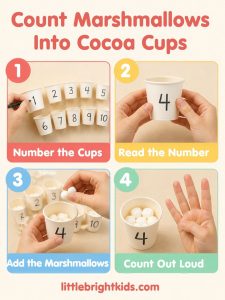
This is the activity from our pin. Kids match the number on the cup with the right amount of marshmallows.
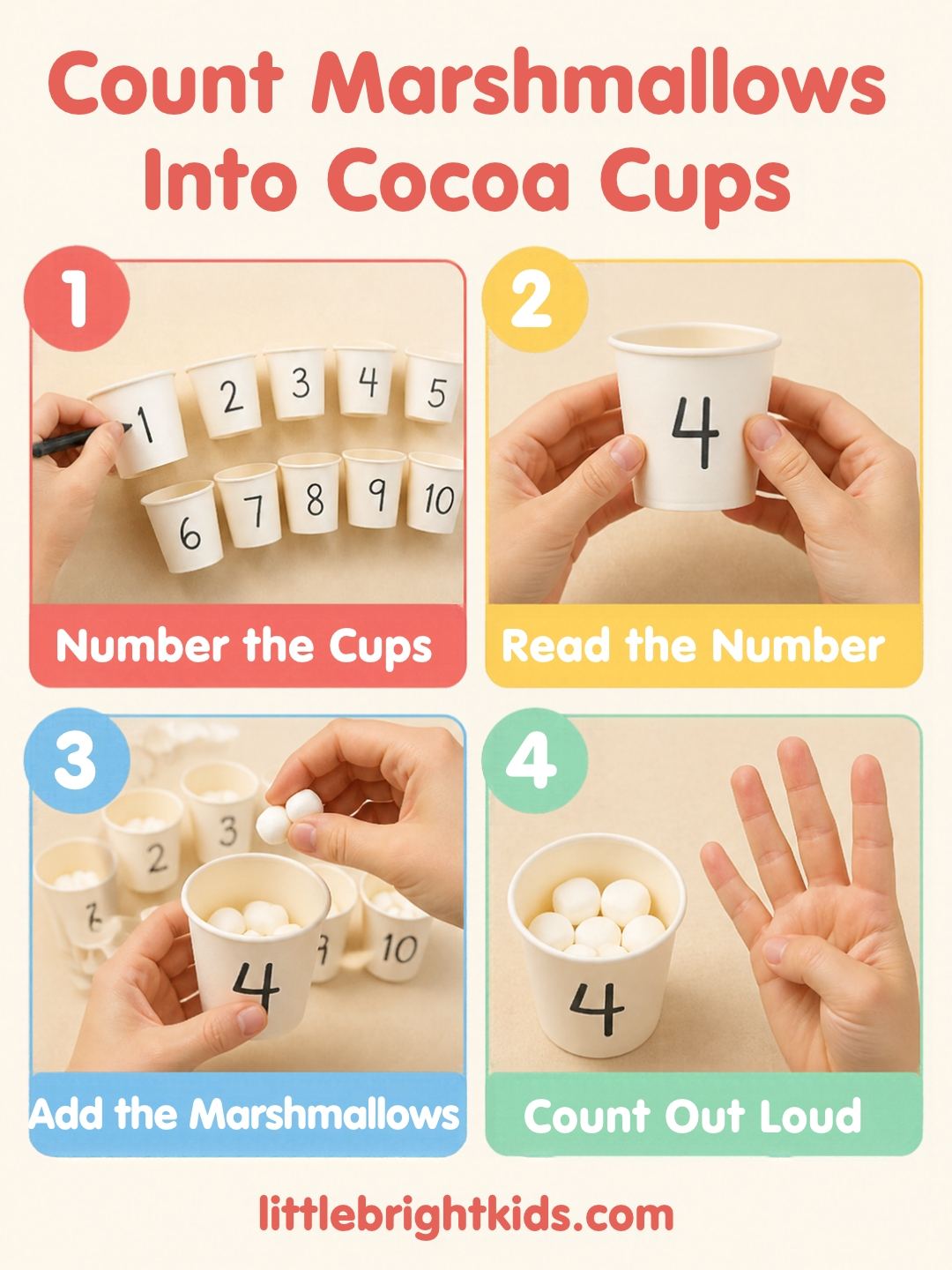
This cozy counting game turns hot cocoa into a math lesson. Each paper cup has a number from 1 to 10, your child reads it and drops in exactly that many mini marshmallows. Counting out loud together at the end lets them check their own work.
What your child learns: Matching a written number to the right amount of objects is a key preschool math skill called number sense. Picking up small marshmallows also builds the pincer grip used for writing.
Make it easier or harder: Use cups 1 to 5 for younger children. Older preschoolers can do cups up to 20 or try to fill two cups that add up to 10.
How to do Count Marshmallows Into Cocoa Cups
- Write 1 to 10 on paper cups.
- Your child reads the number on a cup.
- They drop in that many mini marshmallows.
- Count out loud together to check.
💡 Start with cups 1 to 5 for younger kids.
2. Spoon Transfer Count
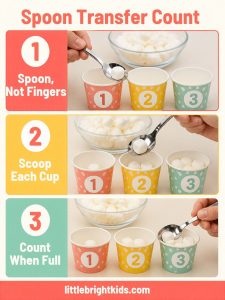
Scooping with a spoon adds fine motor practice to the counting.
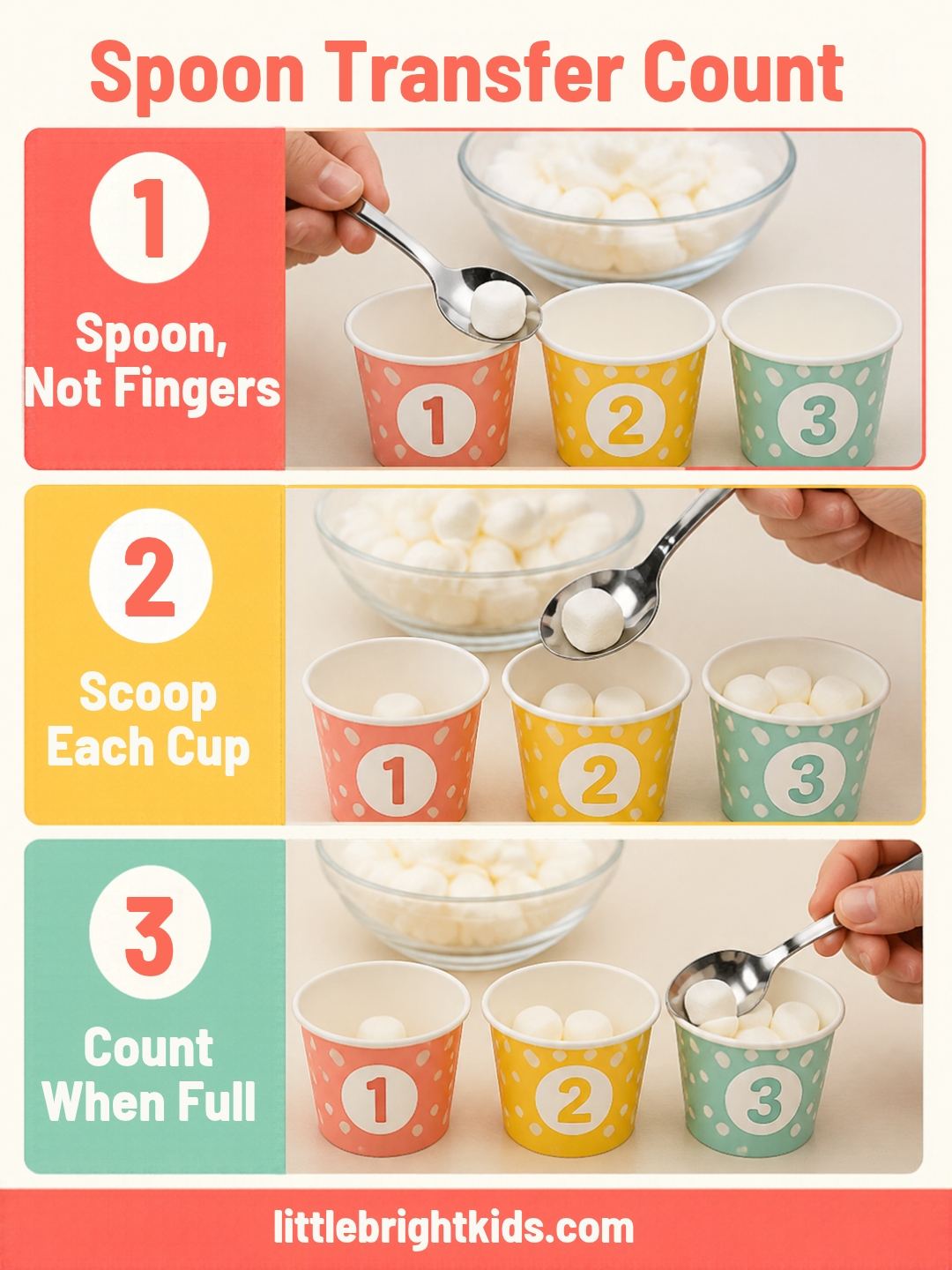
Using a spoon instead of fingers makes counting slower and more careful. Your child scoops marshmallows one at a time into each cup, then counts again when it is full. It is a calm activity that works well before nap or bedtime.
What your child learns: Spoon transfers build hand control, coordination and concentration, which are skills Montessori teachers use to prepare children for writing. Counting twice teaches checking and accuracy.
Make it easier or harder: Use a big serving spoon for toddlers. For older kids, try a smaller spoon, tongs or even a teaspoon to make it more challenging.
How to do Spoon Transfer Count
- Use a spoon instead of fingers.
- Scoop the right number into each cup.
- Count again when each cup is full.
3. Put the Cups in Order
Ordering numbers is the next step after counting.
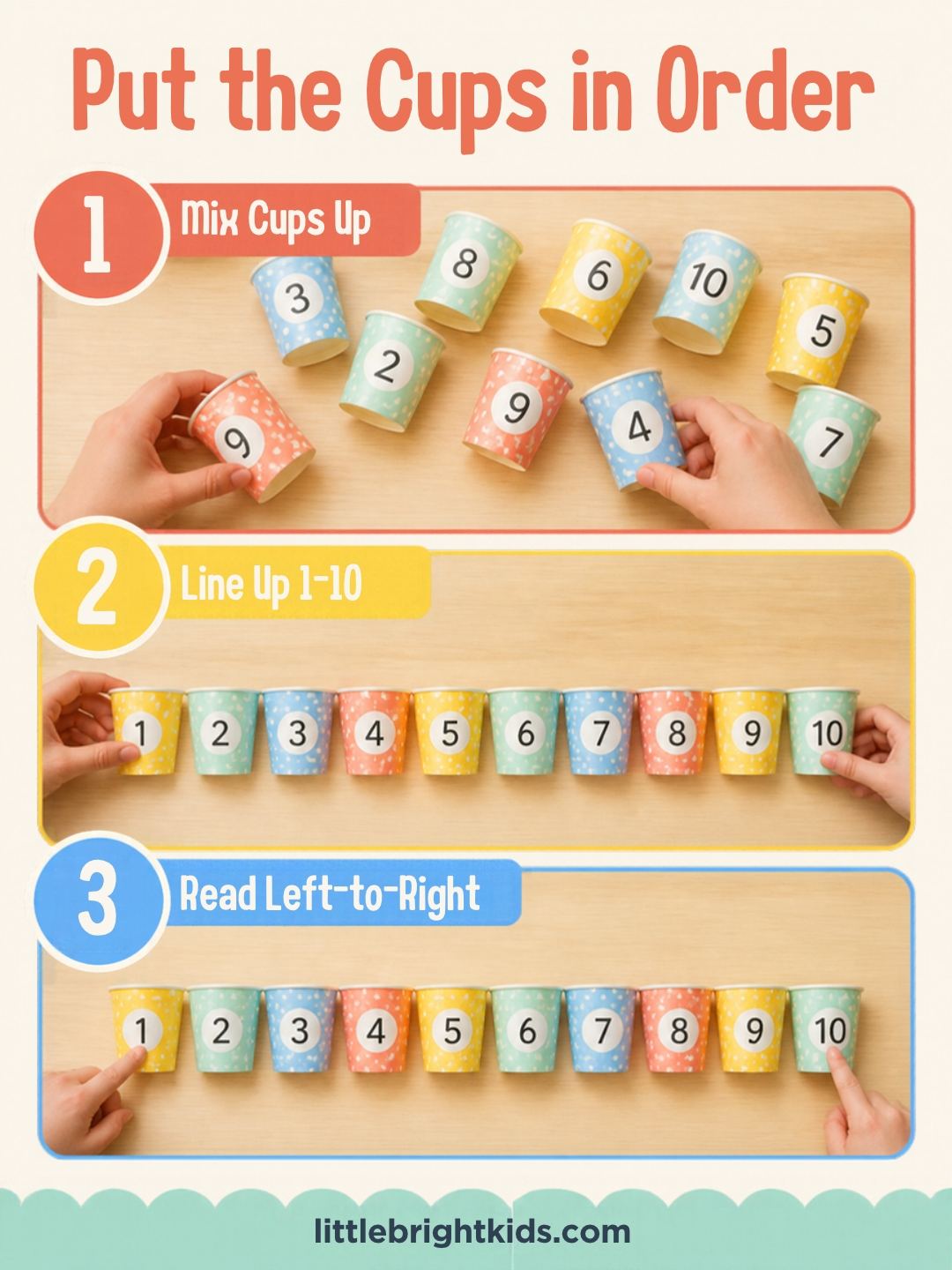
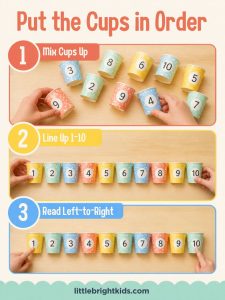
Lining up numbered cups is a simple way to practice number order. You mix the cups, and your child puts them back in a row from 1 to 10. Reading the numbers from left to right afterwards also prepares them for reading words the same way.
What your child learns: Ordering numbers builds an understanding of what comes before and after, and helps children recognize numerals quickly. Working left to right is an early reading habit.
Make it easier or harder: Start with 1 to 5 for little ones. Older children can order cups backwards from 10 to 1 or find a missing cup you hide.
How to do Put the Cups in Order
- Mix up the numbered cups.
- Your child lines them up from 1 to 10.
- Read the numbers together from left to right.
🍪 Snack-size game time
Short on time? This game takes less than a minute. Play it with your kiddo, cheer for every right answer and keep reading after.
4. Marshmallow Adding
Two small groups become one bigger number.
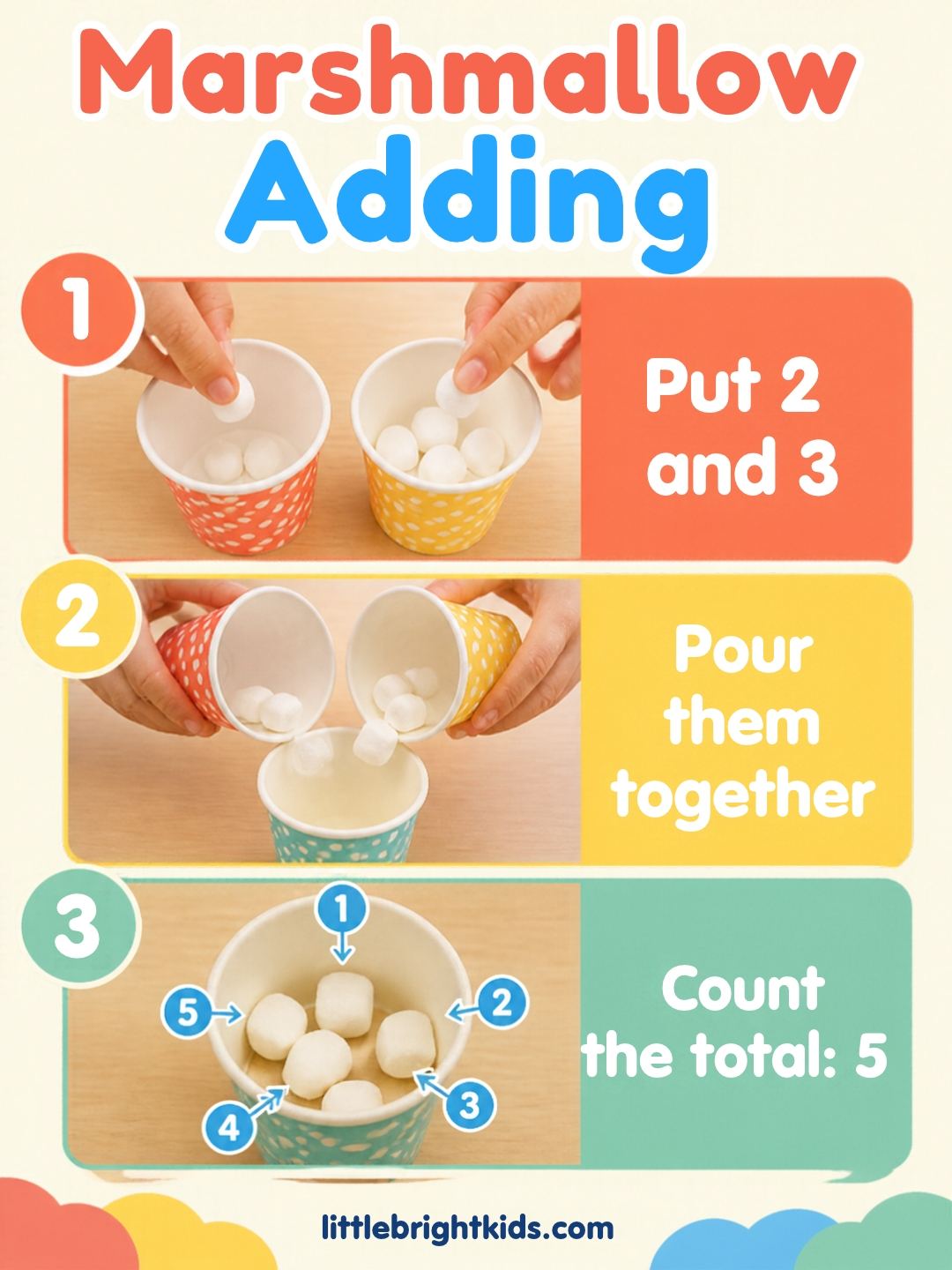
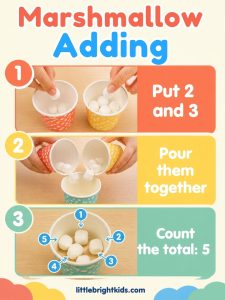
Marshmallow adding shows children that adding means putting groups together. Two marshmallows in one cup and three in another are poured into a third cup, and your child counts the total of five. Seeing the groups join makes the idea of plus easy to understand.
What your child learns: This builds early addition and number bonds in a hands on way. Children can see, touch and count every part of the sum, which makes the math stick.
Make it easier or harder: Keep sums under 5 for beginners. Older kids can try sums up to 10 and write the matching number sentence, like 2 + 3 = 5.
How to do Marshmallow Adding
- Put 2 marshmallows in one cup and 3 in another.
- Pour them together into a third cup.
- Count the total: 5.
5. Roll and Drop
A dice makes the game feel like a real board game.
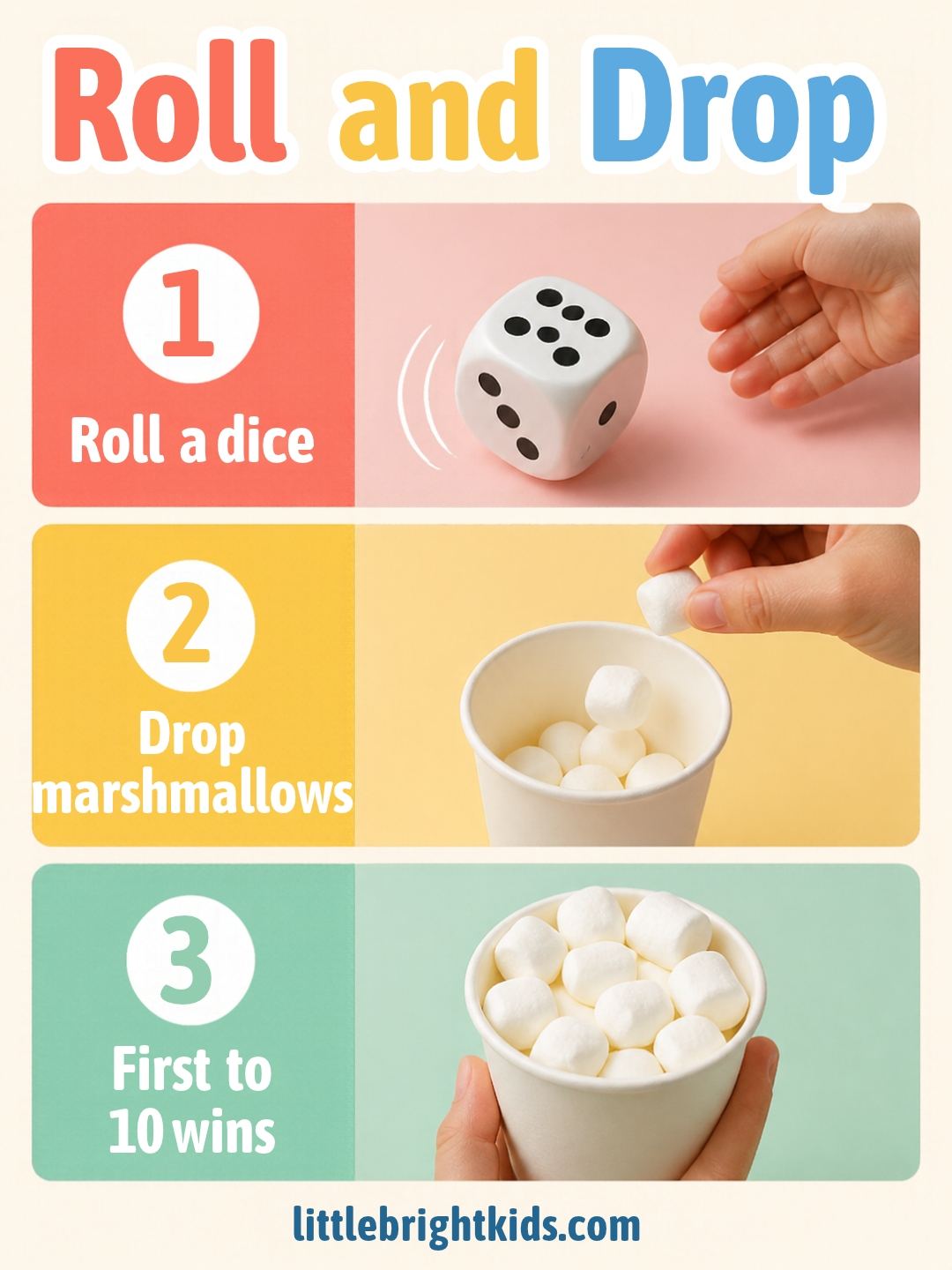
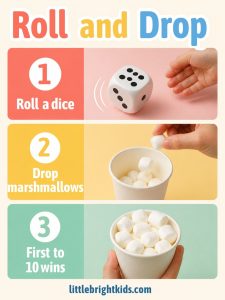
Roll and drop is a quick dice game that kids love to play again and again. Each player rolls a dice and drops that many marshmallows into their cup, and the first to reach 10 wins. It is perfect for siblings or a family game night.
What your child learns: Reading dice dots without counting each one is called subitizing, an important early math skill. Keeping a running total also introduces adding on.
Make it easier or harder: Use a dice with only 1 to 3 dots for toddlers. For older kids, race to 20 or use two dice and add them together.
How to do Roll and Drop
- Roll a dice.
- Drop that many marshmallows into a cup.
- First cup to 10 wins.
5 activitys at a glance
| Activity | Ages | Time | Level |
|---|---|---|---|
| Count Marshmallows Into Cocoa Cups | 3 to 5 | 15 min | Easy |
| Spoon Transfer Count | 3 to 4 | 10 min | Easy |
| Put the Cups in Order | 3 to 5 | 5 min | Easy |
| Marshmallow Adding | 5 to 6 | 10 min | Medium |
| Roll and Drop | 4 to 6 | 10 min | Easy |
For this hot cocoa math activity, write the numbers 1 to 10 on paper cups, then have your child drop that many mini marshmallows into each cup and count out loud together. It takes 15 minutes and needs paper cups, a marker and mini marshmallows.
Free printables to practice at home
Pair the cocoa game with a counting worksheet for more practice.
Tips for hot cocoa math
Use mini marshmallows. They are easier for small fingers to count than large ones.
Make real cocoa at the end and let your child drop in the marshmallows they counted.
Keep a few extra marshmallows for snacking, because some will disappear along the way.
Questions parents ask
What is a hot cocoa math activity?
It is a winter counting game where kids count mini marshmallows into cups labeled with numbers.
What age is this activity for?
It works best for ages 3 to 5. Older kids can try the adding and dice versions.
Is it safe for toddlers?
Marshmallows can be a choking risk for young toddlers, so use big pom poms instead for kids under 3.