This guide brings our favourite Christmas learning activities into one place: letters, names, rhymes, counting, shapes, patterns, sorting, simple science and first steps in math and writing. Every idea uses holiday things you already have, so learning feels like part of the season, not homework.
Most activities take 10 to 15 minutes and work for 3 to 5 year olds, with toddler and kindergarten options marked in each section. Do one a day and you have a full advent of playful learning.
Alphabet & Letters
Letter hunts and ornament ABCs that feel like play.
1. Ornament Letter Match
Hang the matching ornament.
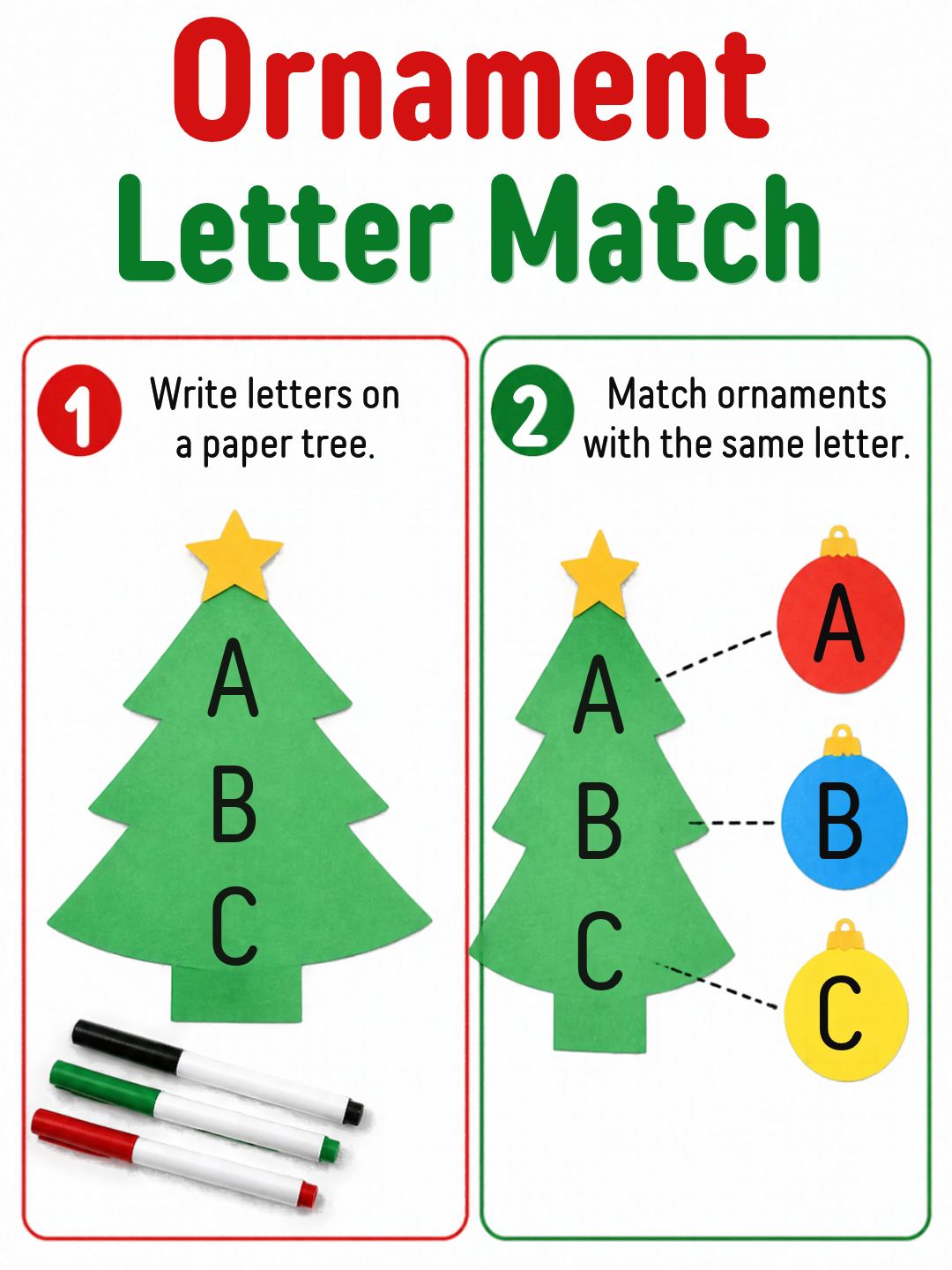
Ornament letter match is a festive matching game. Write letters on a paper tree and have your child match paper ornaments with the same letters. Holiday themes keep letter practice exciting, and short daily games work better for preschoolers than long lessons.
What your child learns: Matching letters builds visual discrimination, an important pre-reading skill.
Make it easier or harder: Start with 4 letters. Older kids can match lowercase ornaments to uppercase letters.
How to play Ornament Letter Match
- Write letters on a paper tree.
- Match ornaments with the same letter.
2. Candy Cane Letters
Build letters like J and L.
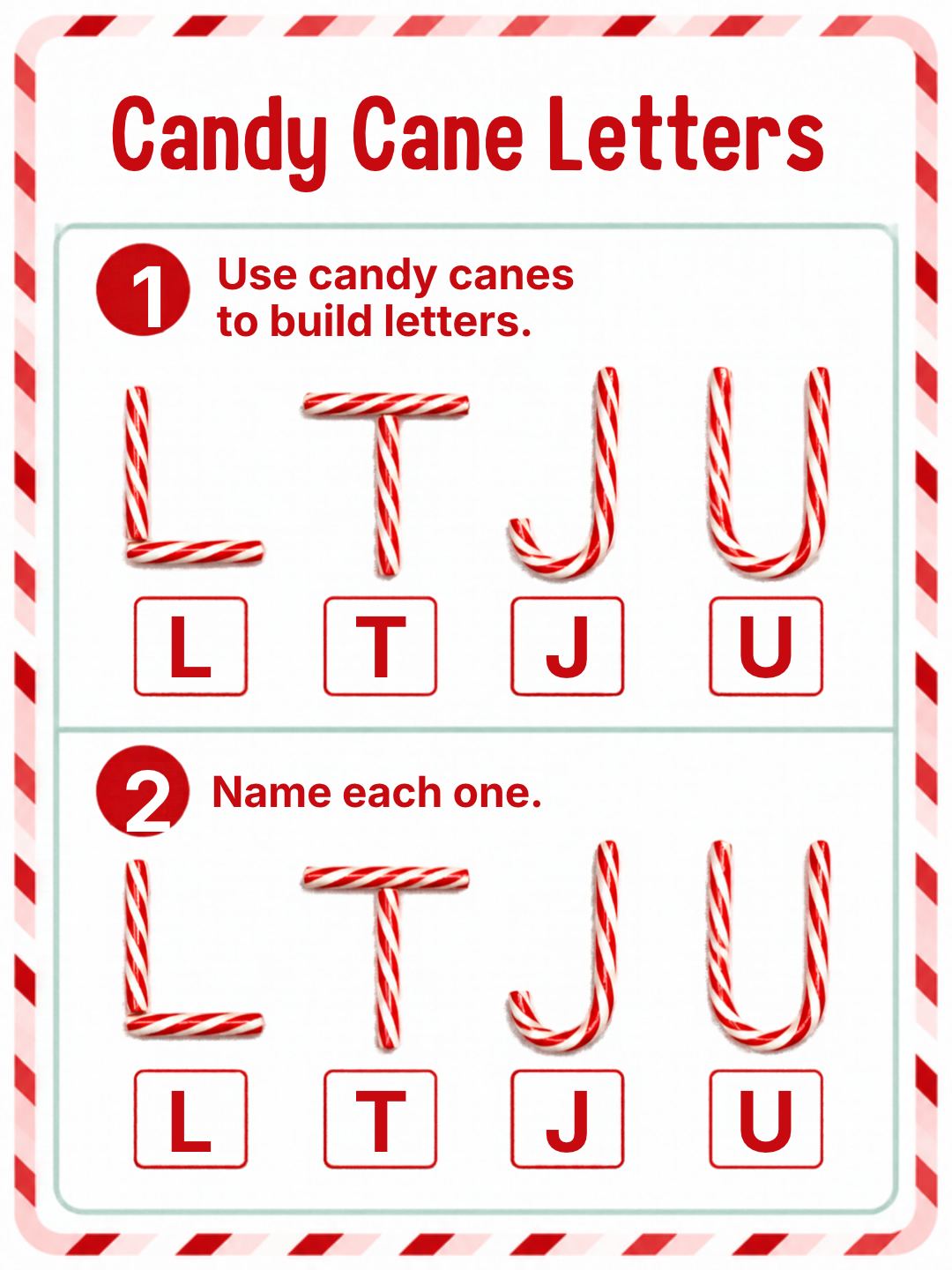
Candy cane letters use the hook shape to build letters. Arrange candy canes to make letters like J, U and M and name each one.
What your child learns: Building letters from parts teaches how letters are made of lines and curves.
Make it easier or harder: Use paper candy canes for younger children. Older ones can build their initials.
How to play Candy Cane Letters
- Use candy canes to build letters.
- Name each one.
Name Activities
Spelling their own name is the most exciting word a preschooler knows.
3. Name Ornaments
One paper ornament for each letter, hung in order.
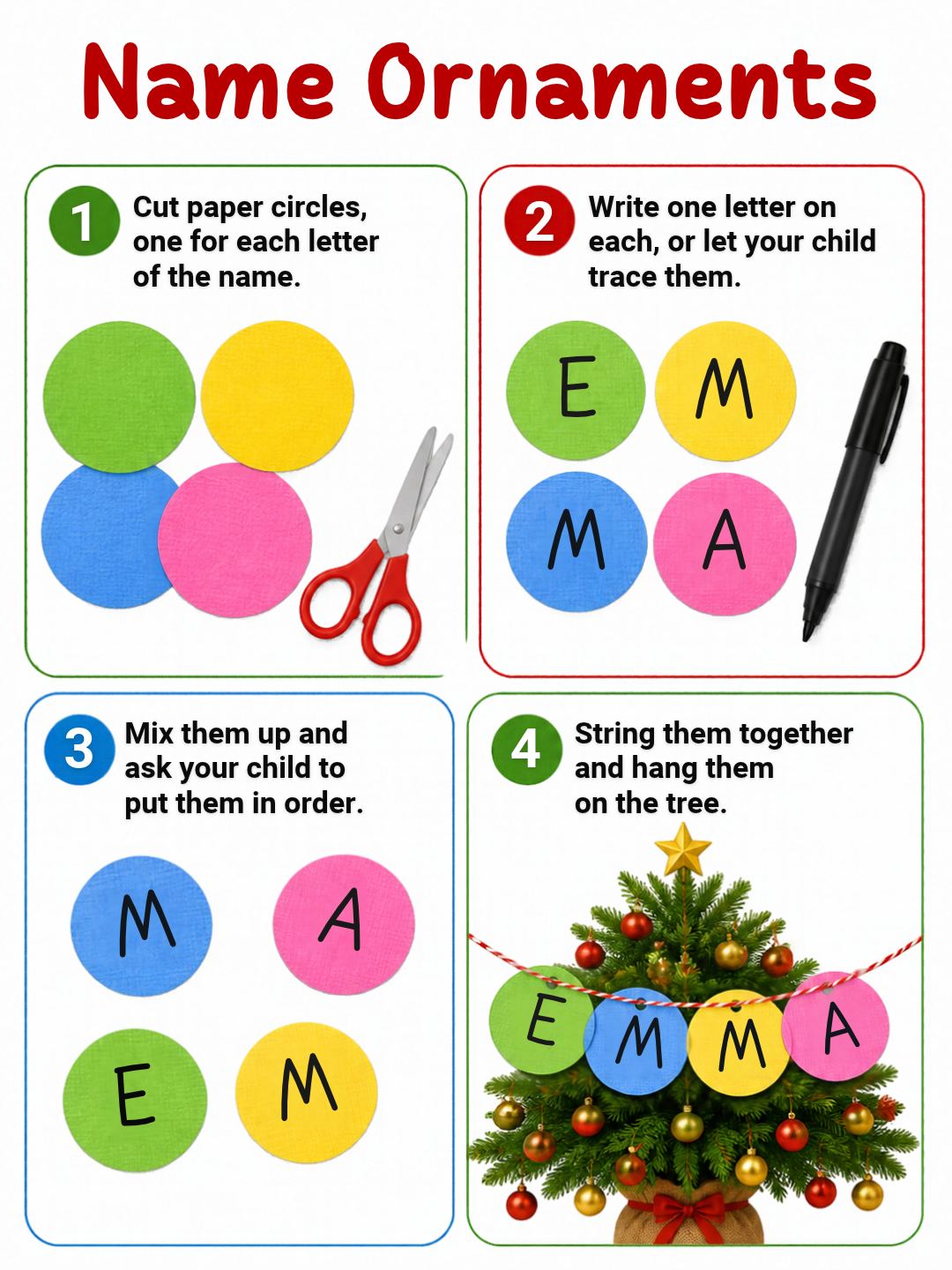
Name ornaments turn your child’s name into tree decorations. Cut paper circles, one for each letter, write one letter on each and hang them in order on the tree. Learning to recognize and write their own name gives preschoolers a big confidence boost, and the letters in their name are often the first ones they remember.
What your child learns: Putting the letters in order teaches that names have a fixed sequence, an early spelling idea.
Make it easier or harder: Write the name on a card as a guide. Older kids can write the letters themselves.
How to play Name Ornaments
- Cut paper circles, one for each letter of the name.
- Write one letter on each, or let your child trace them.
- Mix them up and ask your child to put them in order.
- String them together and hang them on the tree.
4. Name Tree Puzzle
Write the name across a paper tree, cut it into strips and rebuild it.
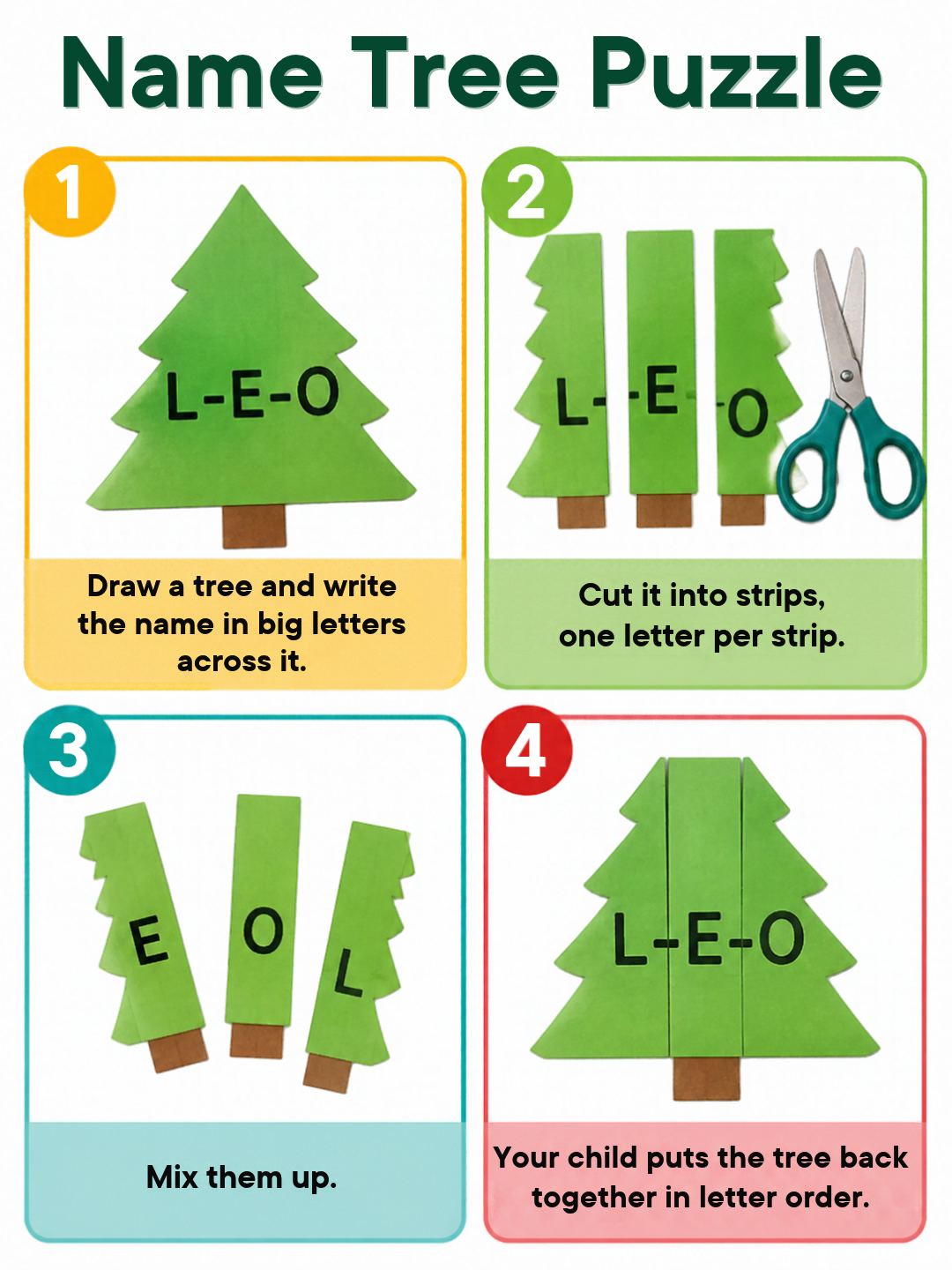
A name tree puzzle makes spelling a game. Draw a tree, write the name in big letters across it, cut between the letters and rebuild the puzzle.
What your child learns: Rebuilding the name strengthens letter order and recognition.
Make it easier or harder: Cut fewer pieces for younger kids. Older ones can make puzzles for family names.
How to play Name Tree Puzzle
- Draw a tree and write the name in big letters across it.
- Cut it into strips, one letter per strip.
- Mix them up.
- Your child puts the tree back together in letter order.
Rhyming Games
Silly holiday rhymes build early reading ears.
5. Rhyming Ornament Match
Hang ornaments that rhyme next to each other on a paper tree.
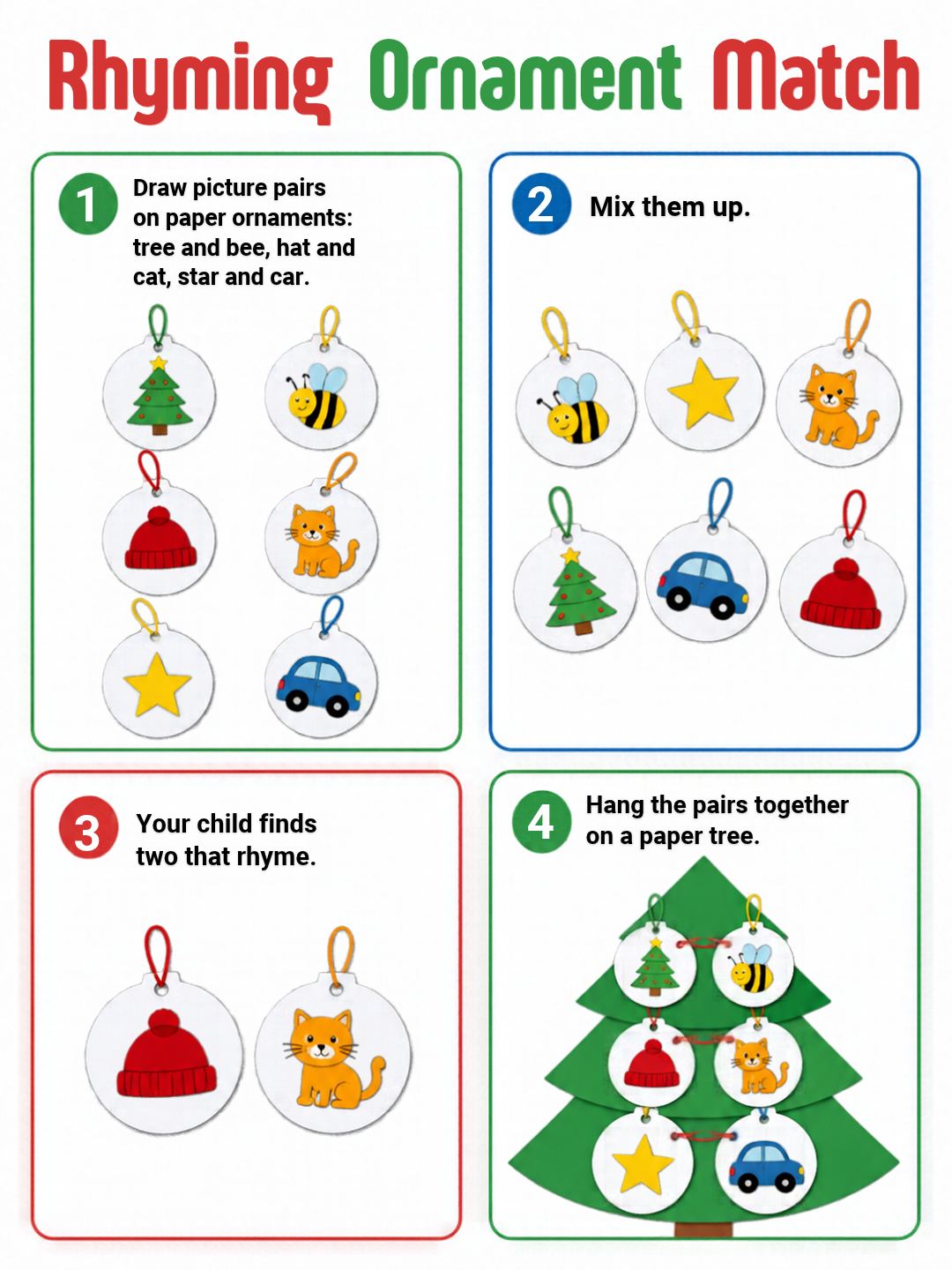
Rhyming ornament match is a festive word game. Draw picture pairs on paper ornaments, like tree and bee or hat and cat, mix them up and match the rhyming pairs. Hearing rhymes is part of phonological awareness, the ability to notice sounds in words. Research shows it is one of the strongest early predictors of reading success.
What your child learns: Saying both words out loud helps children hear the matching ending sounds.
Make it easier or harder: Use 3 pairs for younger kids. Older ones can think of a third rhyming word.
How to play Rhyming Ornament Match
- Draw picture pairs on paper ornaments: tree and bee, hat and cat, star and car.
- Mix them up.
- Your child finds two that rhyme.
- Hang the pairs together on a paper tree.
6. Silly Santa Rhymes
Make up silly rhymes about Santa and his friends.
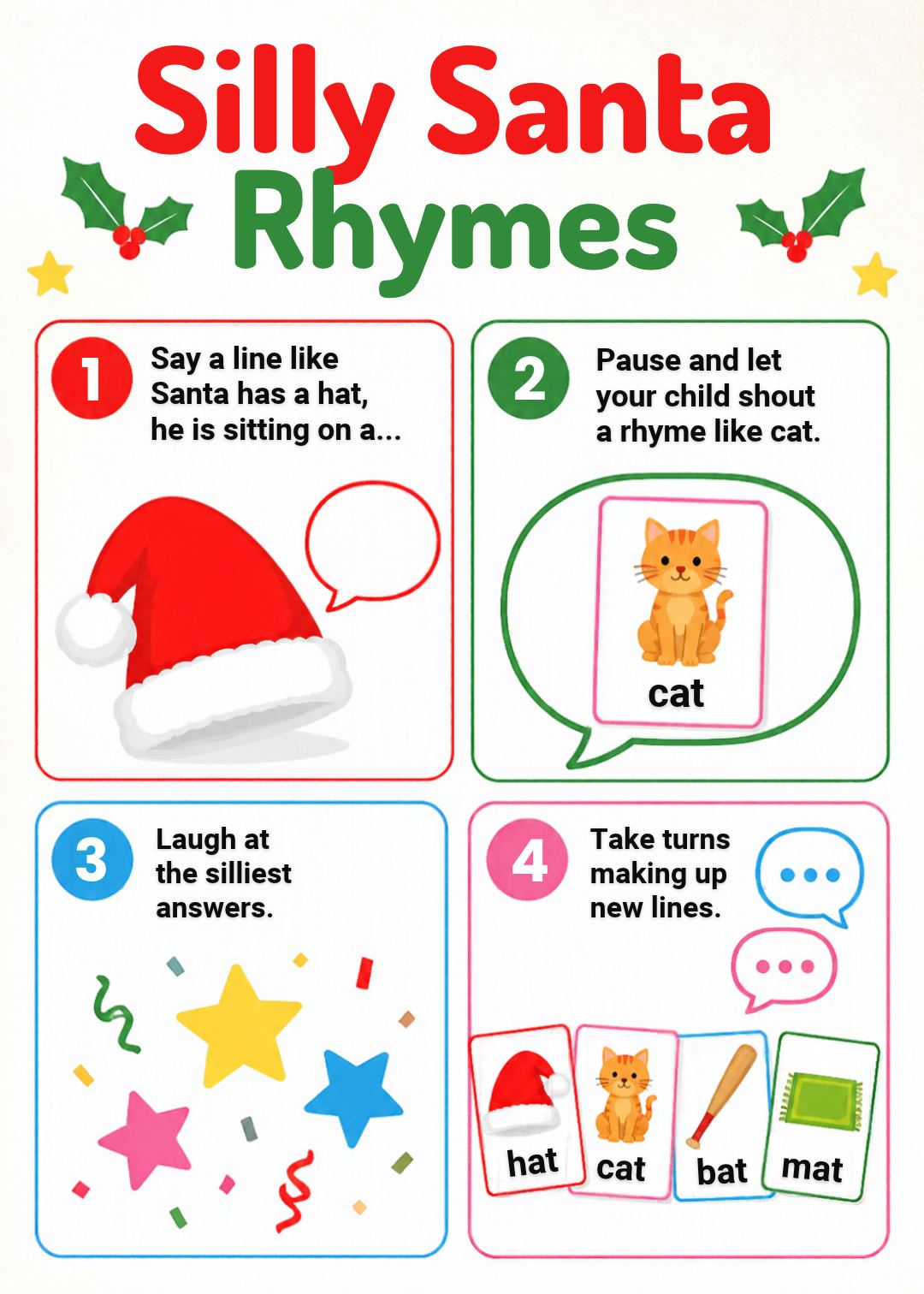
Silly Santa rhymes is a fill-in-the-blank game. Say a line like “Santa has a hat, he is sitting on a…” and pause for your child to shout the rhyme.
What your child learns: Finishing a rhyme builds listening skills and word play.
Make it easier or harder: Give a picture clue for younger kids. Older ones can make up their own lines.
How to play Silly Santa Rhymes
- Say a line like Santa has a hat, he is sitting on a…
- Pause and let your child shout a rhyme like cat.
- Laugh at the silliest answers.
- Take turns making up new lines.
Story Time
Simple ways to turn a Christmas book into a hands-on activity.
7. Story Basket
Put a book in a basket with a few toys from the story to hold while reading.
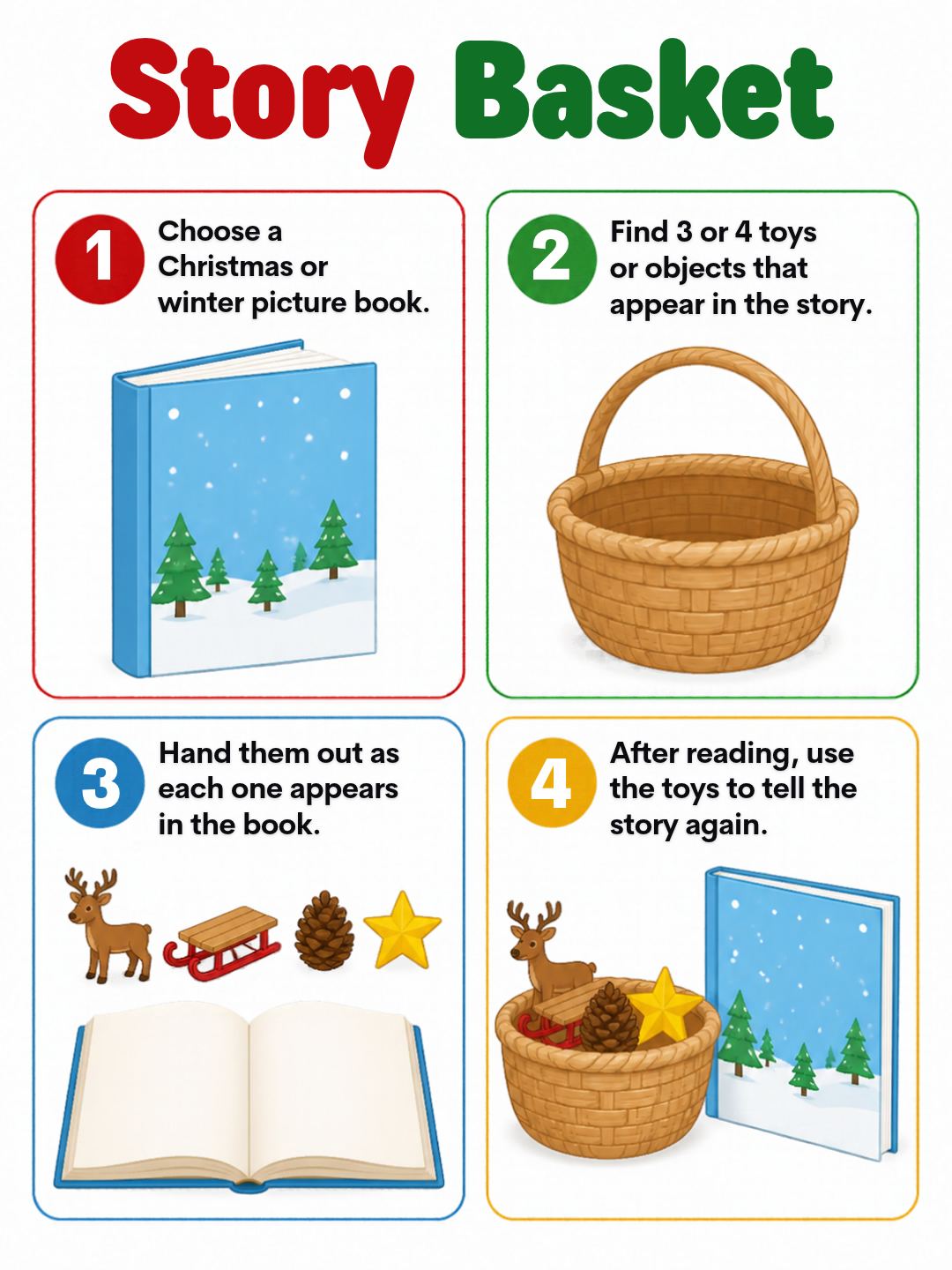
A story basket brings a book to life with toys. Choose a Christmas or winter picture book, find 3 or 4 toys that match the story and use them as you read. Reading aloud every day is one of the best things families can do for early literacy. Adding play to story time helps children understand and remember stories.
What your child learns: Holding story props helps children follow the plot and retell it later.
Make it easier or harder: Let younger kids hold one prop each page. Older kids can retell the story using the props.
How to do Story Basket
- Choose a Christmas or winter picture book.
- Find 3 or 4 toys or objects that appear in the story.
- Hand them out as each one appears in the book.
- After reading, use the toys to tell the story again.
8. Christmas Story Stones
Paint simple pictures on stones and pick a few to make up a story.
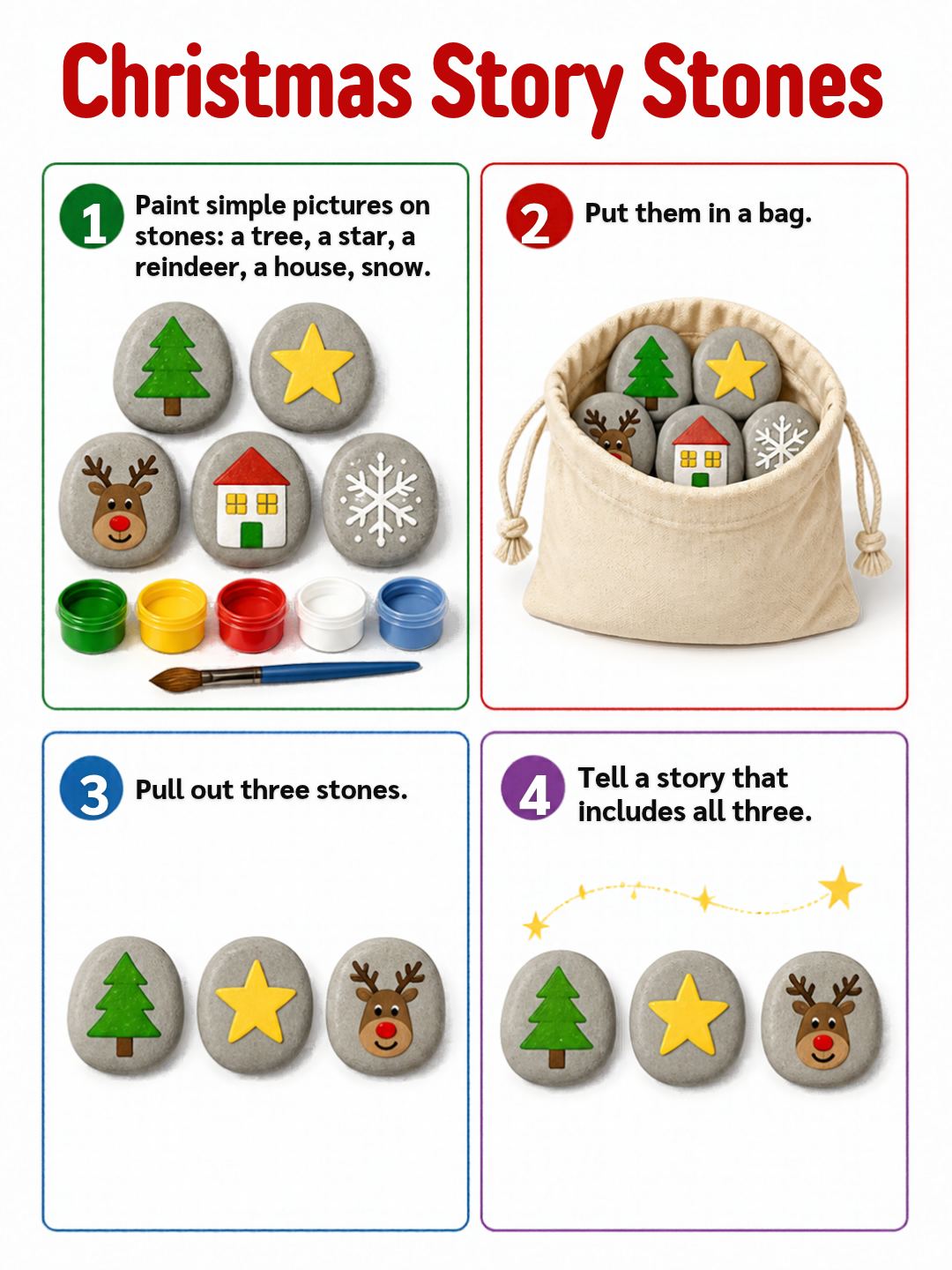
Christmas story stones spark imaginative storytelling. Paint simple pictures on stones like a tree, a star or a reindeer, pick a few from a bag and make up a story.
What your child learns: Creating stories builds language, sequencing and creative thinking.
Make it easier or harder: Start with three stones. Older kids can tell a story with beginning, middle and end.
How to do Christmas Story Stones
- Paint simple pictures on stones: a tree, a star, a reindeer, a house, snow.
- Put them in a bag.
- Pull out three stones.
- Tell a story that includes all three.
🍪 Snack-size game time
Short on time? This game takes less than a minute. Play it with your kiddo, cheer for every right answer and keep reading after.
Counting
Count ornaments, bells and candy canes up to 10 and beyond.
9. Decorate the Tree Counting
Pick a number card and add that many pom pom ornaments to the paper tree.
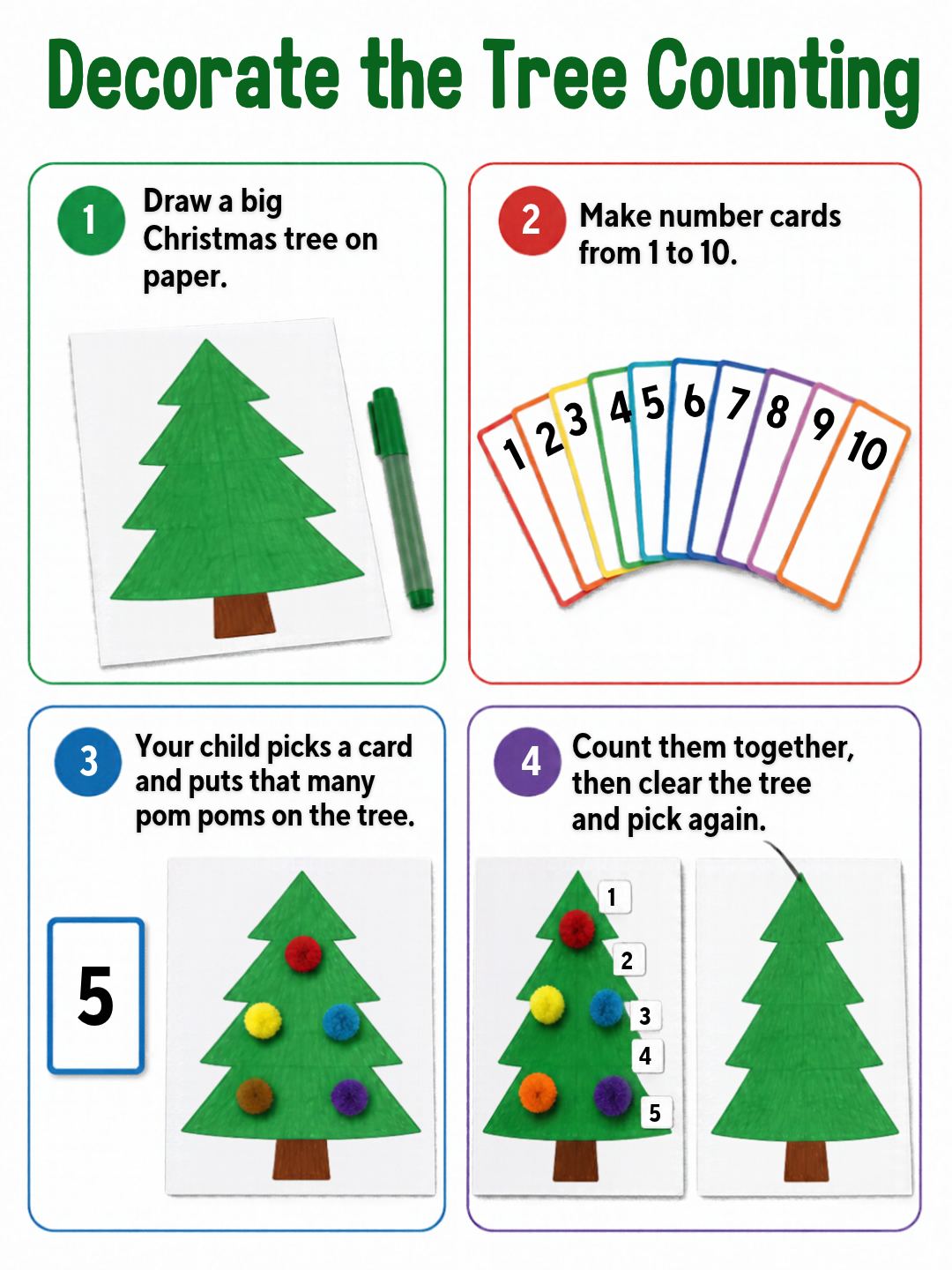
Decorate the tree counting is a festive math game. Draw a big Christmas tree, make number cards from 1 to 10, pick a card and add that many ornament stickers or pom poms. Early math research shows that counting real objects, not just reciting numbers, is what helps preschoolers truly understand quantity.
What your child learns: Matching a number to the right amount builds number sense and one-to-one counting.
Make it easier or harder: Use 1 to 5 for younger kids. Older ones can add two cards together.
How to play Decorate the Tree Counting
- Draw a big Christmas tree on paper.
- Make number cards from 1 to 10.
- Your child picks a card and puts that many pom poms on the tree.
- Count them together, then clear the tree and pick again.
10. Count the Presents
Wrap blocks in paper and count presents under the tree.
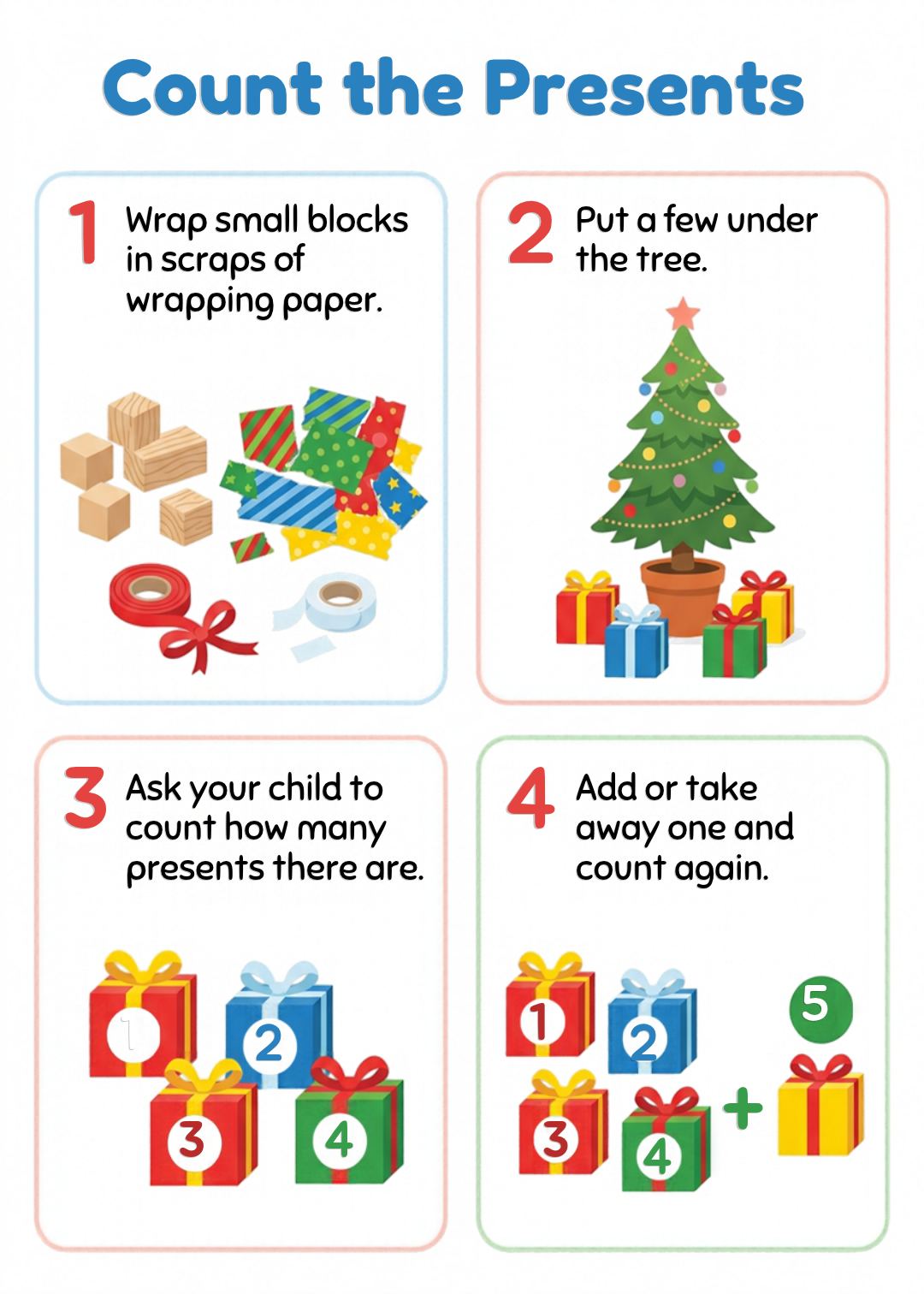
Count the presents uses tiny wrapped blocks. Wrap small blocks in scraps of wrapping paper, put a few under a paper tree and count them together.
What your child learns: Counting objects you can touch helps children connect numbers with amounts.
Make it easier or harder: Add or take away a present and count again to introduce simple adding.
How to play Count the Presents
- Wrap small blocks in scraps of wrapping paper.
- Put a few under the tree.
- Ask your child to count how many presents there are.
- Add or take away one and count again.
Shapes
Spot circles, triangles and stars all over the Christmas tree.
11. Shape Christmas Tree
Build a tree from shapes.
A shape Christmas tree builds a holiday picture from basic shapes. Glue a big green triangle for the tree, add a square trunk and decorate with circle ornaments and a star on top. Research shows that young children learn shapes best when they handle, sort and find them in real life, not just on flashcards.
What your child learns: Naming triangle, square and circle while building helps children remember each shape and its sides.
Make it easier or harder: Pre-cut shapes for younger kids. Older preschoolers can cut their own and count the circles.
How to play Shape Christmas Tree
- Glue a big green triangle for the tree.
- Add a square trunk.
- Decorate with circle ornaments and a star.
12. Ornament Shape Sort
Sorting by shape is early math.
Ornament shape sort is a calm sorting game. Cut paper ornaments in circles, squares and triangles and sort them into groups.
What your child learns: Sorting by shape builds classification skills, an important early math idea.
Make it easier or harder: Use one color so children focus on shape. Older kids can sort by shape and color at the same time.
How to play Ornament Shape Sort
- Cut ornaments in circles, squares and triangles.
- Sort them into three groups.
Patterns
Red, green, red, green: easy patterns with things you already have.
13. Ornament Pattern Strips
Start a sticker pattern on a strip and let your child finish it.
Ornament pattern strips make patterns easy to see. Cut long paper strips, start a pattern with stickers like red, green, red, green and ask your child to continue it. Studies of early math show that understanding patterns in preschool is a strong predictor of later math success.
What your child learns: Continuing a pattern teaches children to predict what comes next, an early algebra skill.
Make it easier or harder: Start with AB patterns. Older kids can try ABB or ABC patterns.
How to play Ornament Pattern Strips
- Cut long strips of paper.
- Start a pattern with stickers, like star, tree, star, tree.
- Ask your child what comes next.
- Let them finish the strip, then make their own.
14. Paper Chain Patterns
Make a long paper chain following a color pattern.
Paper chain patterns turn a decoration into a math lesson. Cut strips in three colors, choose a pattern like red, green, white and loop the strips in order.
What your child learns: Repeating colors in a chain builds pattern recognition and coordination.
Make it easier or harder: Use tape for younger kids. Count the links as the chain grows.
How to play Paper Chain Patterns
- Cut strips in three colors.
- Choose a pattern like red, green, white.
- Loop and glue each strip following the pattern.
- Hang it on the tree when done.
Color Matching
Match red, green and gold for the youngest learners.
15. Ornament Color Match
Put ornaments on the paper that matches their color.
Ornament color match is a simple holiday sorting game. Lay out sheets of red, green and gold paper, hand your toddler shatterproof ornaments one at a time and let them place each on the matching sheet. Most children learn color names between ages 2 and 3. Matching colors comes first, then naming them, so these games are perfect for toddlers.
What your child learns: Matching colors builds visual discrimination and color vocabulary.
Make it easier or harder: Start with two colors. Name each color as they match it.
How to play Ornament Color Match
- Lay out sheets of red, green and gold paper.
- Hand your toddler one ornament at a time.
- Ask them to put it on the same color.
- Say the color name every time.
16. Color Hunt Around the Tree
Look for things on and around the tree in one color.
A color hunt around the tree turns decorations into a game. Pick one color, like red, and look at the tree together to point out every red ornament.
What your child learns: Searching for a color builds attention and color names.
Make it easier or harder: Hold your toddler up to see higher branches. Older toddlers can count what they find.
How to play Color Hunt Around the Tree
- Pick one color, like red.
- Look at the tree together and point to red things.
- Find red things in the room and put them in a basket.
- Pick a new color next time.
Sorting
Sort by color, size and shape with holiday bits and pieces.
17. Red and Green Pom Pom Sort
The simplest sort. Two colors, two bowls.
Red and green pom pom sort is the simplest Christmas sorting game. Mix red and green pom poms in one bowl, put a red and a green paper next to it and let your toddler sort them onto the matching color. Sorting is one of the first math skills toddlers learn. It teaches them to notice how things are the same and different, which later supports counting, patterns and reading.
What your child learns: Picking up pom poms builds the pincer grip while sorting builds early thinking skills.
Make it easier or harder: Use big pom poms and supervise. Older toddlers can use tongs.
How to play Red and Green Pom Pom Sort
- Mix red and green pom poms in one bowl.
- Put a red paper and a green paper under two empty bowls.
- Show your toddler how to put a red one in the red bowl.
- Let them sort the rest.
18. Big and Small Ornaments
Sort ornaments into big and small piles.
Big and small ornaments teaches size words. Gather shatterproof ornaments in two clear sizes, hold one up and ask “big or small?” before sorting them into two baskets.
What your child learns: Comparing sizes builds math vocabulary like big, small, bigger and smaller.
Make it easier or harder: Start with two very different sizes. Older toddlers can line them up by size.
How to play Big and Small Ornaments
- Gather shatterproof ornaments in two clear sizes.
- Hold up a big one and a small one and name them.
- Ask your toddler to sort them into two baskets.
- Hang the small ones low on the tree together.
Science
Melting, fizzing and dissolving with a Christmas twist.
19. Dissolving Candy Canes
Which water melts candy fastest?
Dissolving candy canes is a sweet holiday experiment. Put one candy cane in warm water and one in cold water and watch which one melts away faster.
What your child learns: Kids see that sugar dissolves faster in warm water because the water molecules move faster. Ask your child to guess what will happen first. Predicting and then checking is how young scientists learn.
Make it easier or harder: Add a third cup of vinegar or oil for older kids. Younger ones can just watch and describe the stripes fading.
How to do Dissolving Candy Canes
- Put a candy cane in warm water and one in cold.
- Watch which dissolves first.
20. Fizzy Melting Snowman
A snowman that fizzes away.
A fizzy melting snowman erupts with bubbles. Shape a snowman from baking soda mixed with a little water, freeze it briefly, then squirt vinegar on it.
What your child learns: The vinegar reacts with baking soda to make carbon dioxide gas, which makes the fizz.
Make it easier or harder: Use a tray with sides. Older kids can add food coloring to the vinegar.
How to do Fizzy Melting Snowman
- Shape a snowman from baking soda and a little water.
- Squirt vinegar on it and watch it fizz.
Kindergarten Math
A step up: adding, measuring and graphing for 5 and 6 year olds.
21. Ten Frame Ornaments
Fill a ten frame with ornament pom poms to show numbers to 10.
Ten frame ornaments is a holiday twist on a key kindergarten tool. Draw a ten frame inside a tree shape, call out a number and have your child fill that many boxes with ornament counters. Kindergarten math is about understanding numbers to 20, simple adding and taking away, measuring and shapes. Hands-on games make these ideas concrete.
What your child learns: Ten frames help children see numbers as “5 and some more” and build fast number sense.
Make it easier or harder: Start with numbers to 5. Older kids can show numbers to 20 with two frames.
How to play Ten Frame Ornaments
- Draw a ten frame inside a tree shape.
- Call out a number.
- Your child fills that many boxes with pom poms.
- Ask how many more to make ten.
22. Candy Cane Measuring
Use candy canes as a unit to measure things around the room.
Candy cane measuring is a first measurement lesson. Choose objects like a book, a shoe and a toy, lay candy canes end to end beside each and count how many long it is.
What your child learns: Measuring with a non-standard unit teaches length and comparing before rulers.
Make it easier or harder: Record results in a simple chart. Ask which object is longest.
How to play Candy Cane Measuring
- Choose objects like a book, a shoe and a toy.
- Lay candy canes end to end beside each one.
- Count how many candy canes long it is.
- Write the answers and compare.
Kindergarten Writing
Lists, letters and labels for early writers.
23. Picture Prompt Writing
Look at a picture and write one sentence about it.
Picture prompt writing gives kids something to write about. Show a Christmas picture like a snowman or a tree, talk about it together and have your child draw and write one sentence about it. In kindergarten, writing grows from drawing and labels to short sentences. Using sound spelling (writing words the way they sound) is normal and helps children learn phonics.
What your child learns: Talking before writing builds the words children need to put on paper.
Make it easier or harder: Accept sound spelling. Older kids can write two or three sentences.
How to try Picture Prompt Writing
- Show a Christmas picture, like a snowman or a tree.
- Talk about what you see.
- Your child writes one sentence about it.
- They draw their own picture to match.
24. Sentence Building Cards
Mix up word cards and build a sentence in order.
Sentence building cards make sentences like puzzles. Write simple word cards like I, see, a, tree and star, mix them up and build a sentence together.
What your child learns: Building sentences teaches word order and sight words.
Make it easier or harder: Start with three-word sentences. Older kids can copy the sentence onto paper.
How to try Sentence Building Cards
- Write simple word cards like I, see, a, tree, star.
- Mix them up.
- Your child puts them in order to make a sentence.
- Copy the sentence onto paper.
Questions parents ask
What are good Christmas learning activities for preschoolers?
Ornament counting, letter hunts on the tree, candy cane patterns and Christmas rhyming games are quick, hands-on and easy to set up at home.
How can I teach letters at Christmas?
Hide letter cards on the tree or in a stocking, then let your child find each one and say its sound.
What Christmas math works for 3 year olds?
Counting ornaments into a cup, matching colors and making simple red-green patterns are perfect for 3 year olds.
How long should a learning activity last for preschoolers?
About 10 to 15 minutes. Short and happy beats long and tired.
Are these activities good for kindergarten too?
Yes. The kindergarten math and writing sections add adding, measuring and early writing for 5 and 6 year olds.